San Francisco hold news conference on ultraprocessed foods lawsuit
SanFram-RFP-120825
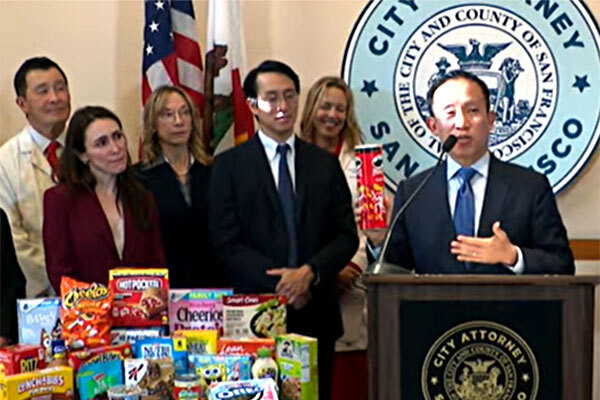
San Francisco officials and their supporters on the city’s lawsuit against makers of ultraprocessed food held a news conference today.
The 64-page suit, filed today in California Superior Court, alleges that the named companies sold and promoted the foods even though they knew there were dangers to public health.
The suit was filed against Kraft Heinz Co., Mondelez International, Post Holdings, The Coca-Cola Co., PepsiCo, General Mills, Nestle USA, Kellogg, Mars Inc. and ConAgra Brands.
At the half-hour news conference, David Chiu, the San Francisco city attorney, said he experienced the addictive nature of ultraprocessed foods himself when his mother bribed him with Pringles to take swimming lessons.
Chiu said the large-scale promotion of ultraprocessed foods began when tobacco companies bought food companies and used the same techniques to sell foods as they had used for tobacco. Chiu also cited the recent case of a Campbell’s executive’s comment that the company made ultraprocessed foods for poor people.
At the news conference, Chiu was backed by representatives of the Department of Health, the San Francisco Board of Supervisors, law firms that are involved in the suit and Kim Newell Green, a pediatrician and professor at the University of California, San Francisco.
Newell Green said she has fought the consumption of ultraprocessed foods in her medical practice and her own home but said she is losing the battle because children find the foods “exciting.”
Alleging that that the companies have engaged in deceptive advertising that violated California’s Unfair Competition Law and public nuisance statute, the suit seeks:
- A statewide order enjoining the defendants from further deceptive marketing and requiring them to take affirmative action to ameliorate the effects of their prior false marketing as set forth;
- An order enjoining the defendants from maintaining the public nuisance in San Francisco that the defendants created or assisted in creating;
- Costs to abate the public nuisance the defendants created or assisted in creating in San Francisco;
- An award of statewide civil penalties to the People of the State of California under Business and Professions Code Sections 17204 for all UCL violations occurring within the State of California;
- Plaintiff’s costs and reasonable attorneys’ fees;
- Any and all further relief available under the applicable laws; and
- Any and all further relief that the court deems appropriate.
Sarah Gallo, senior vice president of product policy for the Consumer Brands Association, said in a statement, “The makers of America’s trusted household brands support Americans in making healthier choices and enhancing product transparency. That’s why food and beverage manufacturers continue to introduce new product options that include increased protein and fiber, reduced sugars and sodium, and no synthetic color additives. There is currently no agreed-upon scientific definition of ultraprocessed foods, and attempting to classify foods as unhealthy simply because they are processed, or demonizing food by ignoring its full nutrient content, misleads consumers and exacerbates health disparities. Companies adhere to the rigorous evidence-based safety standards established by the FDA to deliver safe, affordable and convenient products that consumers depend on every day. Americans deserve facts based on sound science in order to make the best choices for their health.”
Responding to Gallo’s statement, Chiu said he believes there is a “clear understanding” of what constitutes ultraprocessed foods, and he looks forward to having a discussion about ultraprocessed foods in court.
Chiu said the city is bringing the suit at this time because there have been more and more studies that have shown the impact of ultraprocessed foods.
The New York Times first reported that San Francisco would file the suit.