Armageddon: Nebraska devastated by record-breaking firestorm
Ruth Wiechmann Follow
Wildfire-RFP-032326
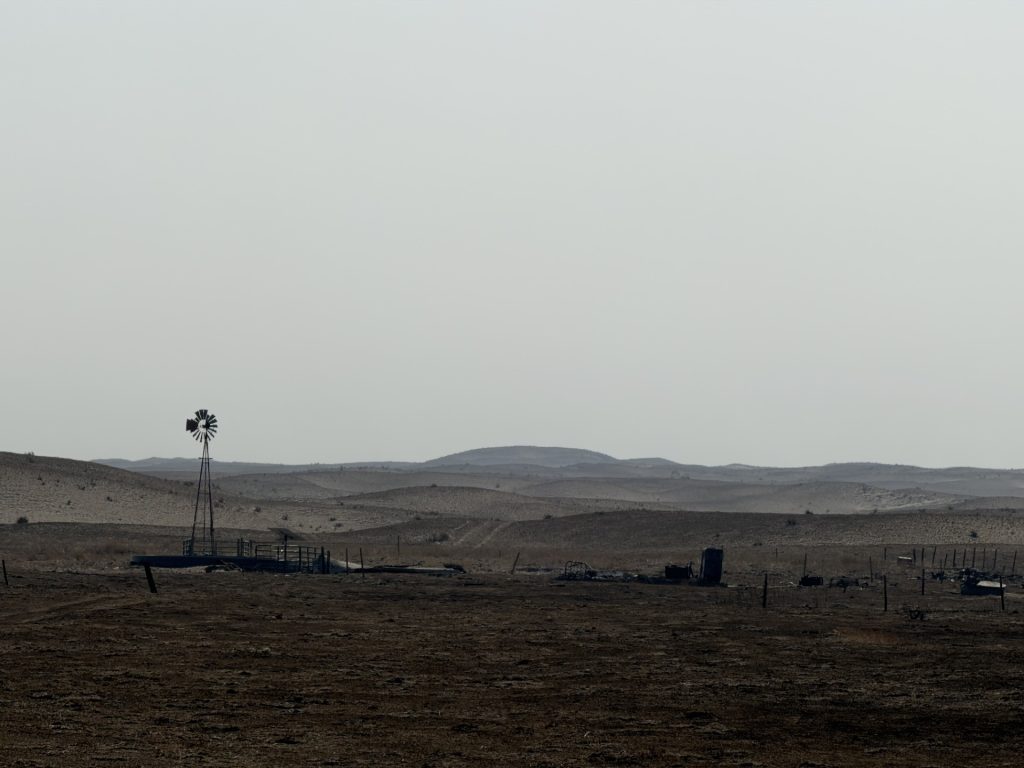
As far as the eye can see across the Nebraska Sandhills of Morrill, Garden, Arthur, Keith and Grant counties, the Morrill fire left behind a landscape unrecognizable, unfamiliar, barren and bleak. Blowing ash and sand fill the skies and shift the contours of hills. Charred remains of life are stark reminders of just how quickly things can change.
But also remaining are the Sandhills ranch families who have called the area home for generations. Their pioneer ancestors faced impossible odds, survived and thrived. So will they.
“It takes a special kind,” said Levi Rauch, who ranches north of Oshkosh. “The pioneers were tough people. They were going to make it, no matter what. That’s how everybody feels with this fire. We are going to make it.”
Red Flag conditions on March 12 spawned multiple fires in Nebraska and surrounding states. Winds of 60-70 miles per hour fanned flames into a firestorm described by volunteer firefighters and ranchers as “Armageddon” and “apocalyptic.” The Morrill Fire, sparked by a fallen power pole, burned 643,074 acres. The Cottonwood Fire, started by causes yet to be determined, burned 128,036 acres in Lincoln, Dawson and Frontier counties. The Road 203 Fire burned 35,916 acres in Thomas and Blaine counties in central Nebraska, and the Anderson Bridge Fire burned 17,400 acres in Cherry County west of Valentine.
Nebraska Gov. Jim Pillen issued an emergency declaration on March 13, bringing state and federal resources to the aid of over 30 local, rural, volunteer fire departments and ranchers with fire rigs who battled the monster blazes through the night of March 12.
INTENSE FIRES AND DENSE SMOKE
In the aftermath of these fires, the scope of their full impact is yet to be tallied.
“I have never seen a deal like this, it was just rolling walls of fire,” said Casper Corfield, who lives 10 miles north of Oshkosh. “I have never seen a sky full of dirt and fire; it was like watching a fog rolling in, but it was sand and fire. It was absolutely incredible.”
Visibility was 10 feet or less at times due to the smoke and blowing ash and dust, Corfield said. Eighty-six-year-old Rose White of Arthur, Neb., lost her life in the Morrill Fire.
“I was born in Oshkosh and lived here my whole life and it was hard to get my bearings. I can’t believe we didn’t lose more ranchers, firefighters or people trying to evacuate. That was all pure luck or grace.”
Corfield lives far enough out of town that he is not a member of a volunteer fire department, but he keeps fire rigs ready on the ranch. He has helped fight several fires, but this fire was wildly different.
“I watched it jump Blue Creek in one place where the creek was 20 feet wide with another 20 feet of sloppy mud and marsh on each side. I couldn’t imagine a fire could jump that, but it didn’t even stutter step. I was spooked two or three times fighting this one.”
At one point during the night of March 12, a tanker truck tried to get Corfield’s attention as he rushed by.
“The tire of my pickup was on fire from driving along the fire line with the wind backdrafting around me and I didn’t know it. He turned on his valve and doused it out.”
Corfield’s place is roughly 30 miles east of where the Morrill Fire started. He was working at Ogallala Livestock when he heard there was a fire near Broadwater. About two hours later, someone told him there was a fire north of Lisco in Garden County, about 12 miles from his place.
“I thought, ‘That can’t be the same fire,'” he said. “By the time I made it home (less than an hour) it had burned through the heart of Garden County and was moving into Arthur County.”
With the high winds driving the fire, Corfield said it was “unreal how fast it could move. Even if the first firefighters got there, even on plumb flat farm ground there was no way they could stop it. And most of this country is only accessible horseback or maybe with a four-wheeler. They tried to get trucks in but there was no way to fight it. Hell, they couldn’t even catch it.”
LIVESTOCK IMPACT
Corfield spent the night of March 12 out fighting fire with other ranchers and volunteer fire department crews.
“People were to the point they were almost visibly ill, fearing they lost everything,” he said. “When daylight came, we were still fighting fire, but people started finding more cattle alive and unharmed than they thought possible. Obviously there have been some bad stories, but all in all, many people were surprised the losses were not as bad as they expected. I’m not going to say there was not loss of livestock, but it came through about like a blizzard. Just as there are places where the snow doesn’t land, there were places where the fire didn’t go. We expected to have mass devastation, but it wasn’t quite as bad as we feared.”
The dry conditions that fed the fire also may have helped spare some of the livestock.
“One saving grace was that a lot of people have their cows in close to calve, and the lots are so dry there is no vegetation in them to burn. The lots are pure sand, so the fire burned around them.”
Corfield has heard of losses in later calving herds that were still on range.
“It burned on two sides of me, and I don’t know why but I didn’t lose anything,” he said.
Flare ups continued for several days.
“We had lot of help Thursday night and the next day more help started rolling in,” Corfield said. “Our volunteers stayed on it full-time Thursday, Friday, Saturday and Sunday. Tuesday, the fire flared up a mile north of my house and Omaha Metro fire trucks came rolling in. Seeing that fancy equipment in the middle of the Sandhills, that was crazy.”
The response from people stepping up to help one another has been phenomenal. Corfield led four semis loaded with hay to a ranch in northern Garden County.
“They came from eastern Nebraska. When we got done unloading hay, the trucker unloaded 17 bags of milk replacer, and his toolboxes were full of calf claim, colostrum, fence staples, you name it. There was just room for him in the seat of his truck.”
No fences are left in the area, Corfield said. Other fires burn some posts and leave some, but not the Morrill Fire.
“It burned everything: hedge posts, creosote posts, corner posts, everything is gone.”
Shelterbelts and tree groves, products of love and tenacity, did not survive the fire. Cattle have irritated eyes from the blowing smoke and sand, and ranchers expect respiratory problems to start showing up. For those who lost grazing land, tough decisions will have to be made.
“These sandhills are alive and moving now,” Corfield said. “New hills and new blowouts are being formed. The ash has blown off the hills and they are pure white. It looks like the Sahara; it’s absolutely pure sugar sand. Sand is drifting across the roads like snow drifts. I don’t know how long it will take to grow back.”
One neighbor has only the grass in his yard between the barn and the house and the outbuildings.
“That’s what grass he has for 350 cows,” Corfield said. “Everything else is gone. We need rain bad, and we’re damn sure going to take whatever we get, but a hard rain could be detrimental. We need long drawn out soakers or a foot of snow.”
The Garden County Sheriff and his family lost their home. Many ranchers lost all their grass. Some lost their feed or feeding tractors. Some outbuildings were lost, and some abandoned structures and landmark buildings burned. Everyone has soot blowing in the windows But, it could have been so much worse, Corfield said.
“As far as I know, everyone except the sheriff still has a roof over their head. The fire crews did a hell of a job, especially with most not knowing the area. Those guys from east are used to roads on every section line; Garden County only has three main roads, and none are worth a damn. It’s pretty easy to get stuck or get lost but they managed to get around with locals helping.
“I want to thank all of the departments that came to help and thank everybody that’s donating. That is the part now that’s making the difference. And pray for rain.”
FAST-MOVING FIRE
“It was insane, but everybody got through it,” Levi Rauch said. The Morrill Fire traveled from north of Lisco to his location, a distance of roughly 12 miles, in about 10 minutes.
Rauch runs Blue Creek Ranch for Lone Creek Cattle Company. Thankfully, they had just pulled 400 fall calvers off pivots, weaned the calves and had them locked up in a backgrounding lot. When they heard about the fire, they brought 150 spring calving heifers into a water trap, where his co-worker was able to disk a fire break around the west side.
“The firefighters kept it from getting to us on the east side,” he said. “It was crazy. I know there were some losses where cattle were still turned out on winter range. Nobody could get to them fast enough.”
Rauch is concerned that he and others will be fighting respiratory issues and stress-related sickness in cattle herds for a long time. The ongoing impact from the stress of the fire and blowing smoke, ash and dirt will be hard to quantify.
“It burned straight down to the sand,” he said. “This morning, with a 20 mile per hour wind we had another dust storm with ash and dirt blowing.”
Rauch is a member of a volunteer fire department. He and a neighbor started fighting the fire together near his house. Then, as they were getting to his neighbor’s house, “the wind switched and things got really bad.”
“It was like an apocalypse. There was fire everywhere you could see. It was crazy. If it wouldn’t have been for our local volunteer fire departments I probably wouldn’t be talking to you,” he said.
One of the worst parts was spending the night not knowing whether his neighbor’s cattle had perished.
“What do you say? You know it might not be as bad as you think, but you had a terrible gut feeling from what you had seen. It was like Armageddon.”
Somehow, the neighbor’s 500 cows on the creek had survived.
“He lost a bunch of hay but didn’t lose a single cow. He found a dead calf, but that calf wasn’t tagged, and he didn’t know where came from. I was super happy when I got back out there at daylight and he had a smile on his face.”
In spite of everything, Rauch said there are good things too. The fire hall is full of pallets of water, medical supplies and food. Hay donations are coming in.
“The outpouring has been awesome,” he said.
Rauch expects pastures will need two years to recover before cows can be turned back out.
“It burned so hard and fast and hot. It’s pretty temperamental out here, you just can’t graze as hard as a lot of people can or you’ll create a blowout.”
If you ranch you know a fire will happen eventually, Rauch said, but it is hard to explain the magnitude of the Morrill Fire.
“With the wind blowing like that you weren’t stopping it. My cousin came out of Omaha on one of the Heli teams. He’s never seen anything like this. You can’t even imagine what it was like being on the ground.”
Thursday, Rauch was not aware how big the fire was.
“I think at that point nobody even cared,” he said. “It was ‘save what you can save keep going.'”
Rauch expressed his gratitude to everyone involved in the firefighting efforts. Long before the fire became a big deal on social media, it was just “a big small-town fire.”
“I just want to thank everybody,” he said. “If we didn’t have neighbors, friends and our community, we might have been in a lot worse shape. It is pretty amazing to watch everyone come together in a split second. It was pretty awesome and still is.”
Hay donations are rolling in.
“I just want to thank rural Nebraska,” Rauch said. “It is pretty awesome how everyone comes together. We’re going to get through it.”
ACRES AND ACRES
The Morrill Fire burned around 12,000 acres of Kyle Anderson’s ranch.
“We are very fortunate that nobody got hurt,” he said. “We lost countless miles of fence, and it burned through one of our ranch headquarters’ but it didn’t burn the shop or the house. It did burn one corral down, but all of our cattle were about a quarter of a mile north and we didn’t suffer any livestock losses. We’re calving now, and you just can’t move new babies.”
Anderson’s ranch is about a mile and a half from the point where the Morrill Fire started, and was the second ranch the fire crossed.
“We’re pretty diversified,” he said. “We had quite a few yearlings that will be going into the feedlot. Our replacement heifers are going to the sale barn. My dad was in Ogallala trying to finish getting yearlings bought and instead he got a phone call that there was a fire. Thank goodness he hadn’t got more cattle bought.”
Anderson is a member of the local volunteer fire department and got the call right away.
“We went north and went straight in; it made it to the Broadwater Alliance Road by the time we got there and there was no jumping in. It was a mile wide at that point or better. The wind was blowing 70 miles per hour. We never saw the north side till it cooled down.”
The magnitude of the Morrill fire was incredible, Anderson said.
“The wind was just relentless. We basically had to stop trying to fight fire and start protecting houses. It was a helpless feeling also. The fire line was so large we were fortunate to not lose any houses with people living in them. There was an old house that burned down, and the old District Five school house burned down, right next to our ranch.”
There was no getting in front of the fire, and there were some close calls.
“Our hired man was headed to get his fire unit to put on the hydra-bed, but the smoke was coming so fast he turned around to get his wife out of the house. When the smoke hit him he couldn’t see and got his pickup stuck. The fire blew right over him. His wife was loading the dogs into the car. When she saw the fire coming, she couldn’t get them back out. She locked them in the car, turned the air conditioning on, ran back in the house and jumped in the shower. The fire blew through; a Broadwater firetruck got him unstuck and she was ok too.”
Within hours, the fire was in Arthur County.
“There was no getting in front of that,” he said.
The terrain made it difficult to fight the fire effectively.
“There are no roads up there, it’s just big country,” Anderson said. “You have to have the rancher lead you in, and then getting tanker trucks back there with water is almost impossible. We drafted a lot of water out of a lot of windmill tanks.”
After the wind switched, fire trucks got pulled to the south line Thursday evening.
Thursday, Friday, Saturday and Sunday were stressful for the ranchers and firefighters, Anderson said. Sunday evening, they were given a mandatory shut down. But the wind blew 60 miles per hour and he couldn’t sleep.
“It scared me to death. I got up and drove around, and my neighbors were out driving around. Then a page came out, there was a flare up in some tree rows.”
The Sandhills will take time to heal. Fences have been damaged, but Anderson said they won’t start fencing until the sand stops moving.
“If we go build a new fence now it will get buried in sand drifts,” he said.
Conditions are still prime for fires in the area.
“The wind still blows and it is still dry. It has got to rain.”
Anderson hopes to never see a fire like the Morrill Fire again.
“The way the community has supported us, and all the outpouring of help coming in from everywhere is just amazing and humbling,” Anderson said.
WIND DRIVEN
Jim Rice ranches 33 miles northeast of Oshkosh on the Grant County line, roughly 60 miles east of where the Morrill Fire started, and on the northeast edge of the fire area.
“Our volunteer fire department got the call for mutual aid about 3:30 p.m.,” he said. They engaged the fire on Blue Creek, north of Oshkosh.
“We set on a house for about 15 minutes while it blew through us, and we did save the house. My understanding is very few living structures were destroyed. There were a few landmark buildings lost along with other structures.”
After fighting fire all night, Rice went home Friday morning as the sun was coming up. The phone rang about 9 o’clock: the wind had switched direction and was sending a finger breakout their way.
Rice talked with many other firefighters who all said the same thing: they had never seen a fire change direction so many times.
“It was so sporadic and so unpredictable,” he said. “The sheer speed of this fire was breathtaking. At one point it was clocked traveling 10 miles in 14 minutes.”
The “perfect storm” of conditions combined to create the largest wildfire on record in the state.
“Humidity levels were low, our grass was extremely dry and the wind was ferocious. It was just an awful, awful thing. It was pretty hair raising.”
Rice was unable to confirm cattle losses, although he had heard of some lost north of Lewellen and heard of some buffalo losses on one of the Turner ranches.
“I haven’t heard much but I know it is there. Everyone is calving. We were out there fighting fire at a neighbors’ place and cows were walking around with a water bag out and there were babies on the ground while we were trying to put out the fire.”
All the smoke and now ash and sand blowing are going to be hard on livestock, Rice said.
“It’s a terrible sight,” he said. “Right here where I’m at we were extremely lucky. The fire stopped about three-quarters of a mile from our house Friday evening. The only reason that happened was the wind switched direction. That saved us and our neighbors to the north too. The fire lost steam and fuel and put itself out. Just a mile west of me, people were completely burned out.”
Hay donations are coming in. Some neighbors are shipping cattle out, many are looking for grass. Rice believes restoration will come, although it will take time. He has seen the Sandhills recover from fire before and this gives him a sense of hope.
“We had a late-summer fire during the 2012 drought. The hills were bare all winter and the winds blew and blew. But the next year we got rain in the spring and summer and by fall you couldn’t tell there had been a fire there. These hills will recover if they get rain. That’s what I’m holding on to.”