Crop insurance key but must do more
CropInsurance-RFP-021626
INDIAN WELLS, Calif. — A series of speakers at the Crop Insurance Industry Annual Convention said here Monday that crop insurance remains the most important part of the farm safety net, but that the program must provide more coverage for specialty crops and signaled that there are problems in the southern states where rice and cotton are suffering from a variety of problems.
The Agriculture Department’s Risk Management Agency pays for about two-thirds of farmers’ premiums and the One Big Beautiful Bill Act included additional subsidies to assure the stability of the program amid the current problems in the agriculture sector.
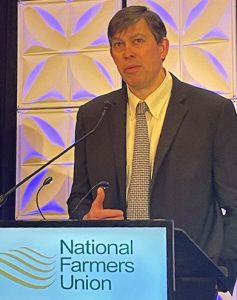
Andy Caruso, the vice president and general manager at Farm Bureau Crop Insurance Services and the chairman of National Crop Insurance Services, said as farmers have faced high input costs and interest rates while crop prices are soft and international markets uncertain, crop insurance has been the farmers’ “first line of defense.”
He noted that indemnity payments from crop insurance arrive much faster than ad hoc disaster relief.
Dale Perry, the president of the crop division at the Great American Insurance Group and chairman of the American Association of Crop Insurers, noted that farmers still face the weather in addition to the pressures that Caruso mentioned.
Perry said Congress’ willingness to increase spending for crop insurance in the One Big Beautiful Bill Act proved that crop insurance is the “backbone” of agriculture and reflects the diversity of American agriculture.
AACI President Scott Graves highlighted that the OBBBA:
- Supplemented the subsidy for administrative and operating expenses for eligible contracts in states in which the loss ratio for crop insurance is above 120%.
- Adjusted the reimbursements for administrative and operating expenses for inflation.
- Established a minimum administrative and operating expense reimbursement of 17% of premium or higher for specialty crops.
- Made the poultry pilot program nationwide.
Graves also noted that crop insurance is so “extensive” that if you can grow a crop “or argue with Mother Nature about it,” there is a policy to cover the crop.
Every commodity has understood the need to not pit one commodity against another, Graves said. “What has made it successful has been affordability, proper policy and geographic and commodity diversity,” he added.
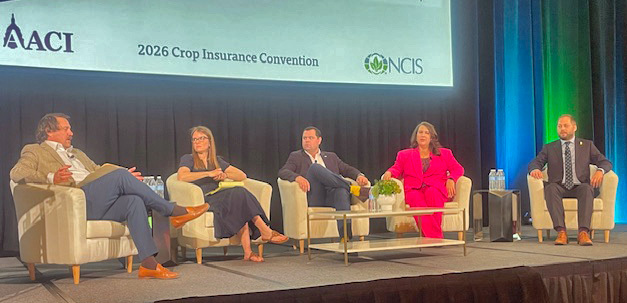
A panel of farm and conservation leaders emphasized that the crop insurance program provides stability in rural America and is expanding to provide services to livestock producers, specialty crops and new and beginning farmers.
Julia Peebles of Ducks Unlimited, a group that conserves, restores, and manages wetlands and associated habitats for waterfowl, noted that conservation compliance requirements protect wetlands and that the crop insurance industry has “stood up” for conservation in farm bill debates. Ducks Unlimited has nearly 1 million supporters and many of them are farmers, Peebles noted.
“This is a marriage and we are not breaking it,” Peebles said.
Wayne Stoskopf of the National Corn Growers Association, R.J. Layher of the American Farm Bureau Federation, and Virginia Houston of the American Soybean Association all said that crop insurance must remain both affordable and actuarially sound, meaning that over time, indemnity payments paid out to farmers should equal the total premiums invested into the system.
Premiums need to be high enough to make the program actuarially sound, but low enough to attract broad participation, Stoskopf said.
If a farmer decides to self-insure, that takes acres out of the program and if there is a crop failure the farmer might want the government to intervene, Stoskopf added.
Amid reports that some rice and cotton farmers in Arkansas, Texas and Mississippi are having trouble finding crop insurance agents to insure them following the large losses in recent years, Stoskopf noted that farmers feel loyal to their agents but do want a choice of agents so that the agents will compete to offer the best service.
(Tom Zacharias, president of National Crop Insurance Services, the crop insurance research organization, told The Hagstrom Report that “margins are thinner” in the crop insurance business but that ultimately all growers are able to get insurance.)
Layher noted that, like in other parts of agribusiness, there has been consolidation among approved insurance providers and that there are now only 14 providers.
“We don’t want to see any more contraction,” Layher said.
Houston added, “If there are fewer choices for farmers, that could drive the cost of crop insurance up.”
Stoskopf said it is easy for farmers in states where corn and soybeans are the main crops to think that “everything is working perfectly” in crop insurance, but that it is important to broaden the types of policies in order to maintain nationwide support for the program.
Stoskopf noted that corn is grown in states beyond the “I” states of Iowa, Indiana and Illinois, which are known as the centers of corn production.
When USDA approved a hurricane policy that didn’t seem to mean much to the corn growers but when Georgia and other southern states were hit with a hurricane, corn was the No. 1 crop to be indemnified, he said.
Stoskopf also said that the development of specialty crop policies is important when crop insurers go into the offices of members of Congress from California to shore up support for the program.
Members of the commodity panel highlighted that there are going to be many retirements in the House this year and that the makeup of the Senate Agriculture Committee will change in the next Congress due to retirements. Those developments will necessitate a large-scale effort to educate Congress about crop insurance, they said.