Million metric ton markets reflect committed customers, buying opportunities
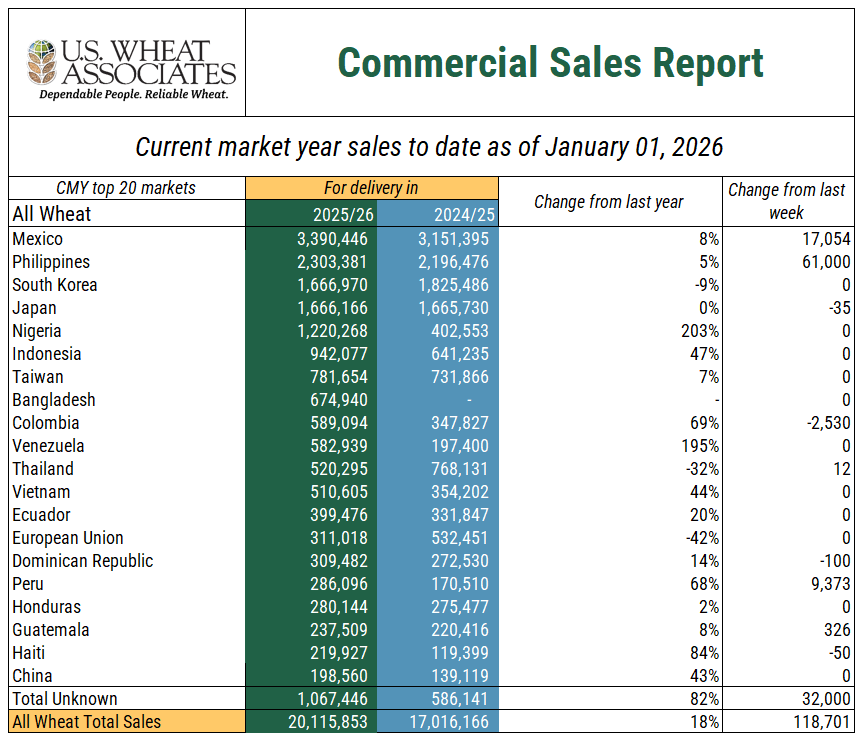
With catch-up reporting complete for the U.S. Department of Agriculture’s commercial sales reports, wheat farmers have a better picture of the first seven months of the 2025/2026 marketing year. Data reported as of Jan. 1, 2026, indicates the United States has sold 20.1 million metric tons (MMT) (nearly 739,000 million bushels) of wheat to international customers. Year-over-year sales are 18% ahead of last year’s pace, with seasonal slowdowns expected for the first part of 2026.
The increase in sales, particularly to the top five customers, reflects not only competitive pricing on the world market, but also the long-standing relationships developed by U.S. Wheat Associates (USW) staff around the globe. For Wheat Letter, USW took a look at each of the year’s top customers, the top five of which have already purchased more than 1.0 MMT (36.7 million bushels) each thus far in the 2025/2026 marketing year.
MEXICO
From treats like churros to daily staples like bolillo bread, Mexican consumers love wheat-based foods. High-quality U.S. wheat is the critical ingredient for these staples, but strong partnerships between U.S. wheat farmers and their Mexican customers are what truly keep Mexico as the top U.S. wheat market.
As of Jan. 1, 2026, Mexico has purchased 3.39 MMT (nearly 124.6 million bushels) of U.S. wheat, an 8% increase from last marketing year but slightly below the five-year average. Mexico currently ranks as the top buyer of U.S. hard red winter (HRW) and soft red winter (SRW) wheat and the second largest buyer of hard red spring (HRS) and durum.
Trading frameworks have also strengthened relationship and logistical trade flows between Mexico and the United States. U.S. wheat exports to Mexico have increased substantially in both volume and share of total U.S. wheat sales. In the first year of the North American Free Trade Agreement — the predecessor to the United States-Mexico-Canada Agreement — Mexico imported nearly 625,000 MT (23 million bushels), compared to almost 4.0 MMT (147 million bushels) in the first full year of USMCA implementation.
PHILIPPINES
The Philippines is the world’s largest importer of both HRS and U.S. soft white (SW) wheat — and that is no accident. For more than six decades, USW and its legacy organizations have maintained an office in Manila and relationships with the country’s milling and baking industries.
Most recently, three consecutive years of U.S. drought, coinciding with bumper crops from competing exporters, resulted in a decline in exports in the 2022/2023 marketing year to the lowest export levels since 2013/2014. While not fully recovered to pre-drought levels, U.S. wheat exports are now rebounding, driven by an increase in available wheat supplies and competitive pricing. As of Jan. 1, 2025, the Philippines has purchased 2.30 MMT (84.5 million bushels) for the marketing year, up 5% year-over-year.
SOUTH KOREA
South Korea, one of the largest and most consistent buyers of U.S. wheat, powered by the long-standing cooperative partnership between USW and South Korea’s milling industry.
Despite headwinds like a declining population and an economic slowdown, recent increases in exports of South Korean-produced instant noodles and bakery products have boosted demand for U.S. wheat. In the 2025/2026 marketing year, South Korea has purchased 1.67 MMT (nearly 61.4 million bushels) of U.S. wheat, a 9% decline year-over-year, but in line with the five-year average. South Korea is currently the second largest buyer of SW and the fifth largest buyer of HRW and HRS.
The global popularity of Korean instant noodles is driving major manufacturers to expand production capacity in 2026, which will significantly boost demand for instant noodle flour and, in turn, U.S. wheat. This success results from years of collaboration between USW, South Korean noodle manufacturers and other industry partners to develop cost-effective, high-quality blends of U.S. wheat classes tailored for noodle production.
JAPAN
Japan has been a consistent customer of U.S. wheat from before USW was even officially formed as an organization. This trade relationship has spanned decades, and Japan has cumulatively purchased more U.S. wheat than any other country.
As of Jan. 1, 2025, Japan has purchased 1.67 MMT (nearly 61.4 million bushels), in line with last year’s purchases. Japan currently ranks as the third largest market for HRW and SW and the fourth largest market for HRS.
Under a system unique to Japan, MAFF — as a government agency — is the only entity that can import wheat without paying duties. MAFF then acts as a broker for Japanese flour millers. MAFF also sets the standard for quality testing, chemical residue testing and other purchase specifications. As a result, mutual cooperation between MAFF, USDA and USW is critically important for enabling the continuous production of wheat varieties suitable for the Japanese market and ensuring that those supplies meet MAFF’s stringent purchasing standards.
NIGERIA
With an estimated population of 224 million, Nigeria is Africa’s most populous country and accounts for approximately half of West Africa’s population. Like many price-sensitive markets in Africa, bread demand in Nigeria is elastic and affected by the price of wheat and the supply of competing local crops like cassava, corn and rice.
Nigeria is the 10th largest importer of wheat in the world, but U.S. market share has declined in the past decade, falling from a high of 91% in the 2010/2011 marketing year to 5.1% in 2023/2024. Nigeria first looked to cheaper origins during a foreign exchange crisis in 2014 and the country imports from all major world wheat suppliers depending on price.
Despite the fierce competition, USW has remained highly engaged in the Nigerian market, working with the flour largest milling groups to provide market and quality information and technical assistance to help these companies support the country’s growing wheat foods industry.
As a result of that engagement, when U.S. wheat prices became competitive in the 2025/2026 marketing year, Nigeria has increased purchasing. As of Jan. 1, 2025, Nigeria has purchased 1.22 MMT (44.8 million bushels), the most since the 2021/2022 marketing year.
HONORABLE MENTION: INDONESIA
Indonesia is not a MMT market this year — yet — but they are one purchase away. Indonesia is one of the largest wheat importers in the world, but the market is highly competitive. Indonesian wheat consumption for food use has increased by 22% over the past decade. Rapid growth in demand for wheat foods is expected to continue, including higher quality products favoring flour from U.S. wheat classes.
Indonesia has imported an average of 500,000 MT (18.4 million bushels) from the United States over the last five marketing years. However, wheat sales to Indonesia are up significantly this year after APTINDO, Indonesia’s flour milling association, signed a Memorandum of Understanding with USW in July. Under the agreement, APTINDO committed to double its annual purchases of U.S. wheat to 1 MMT (36.7 million bushels) each year for the next five years.
Indonesian millers have followed through on that commitment, importing 942,000 MT (34.6 million bushels) thus far in the 2025/2026 marketing year, the most since the 2020/2021 marketing year. USW has kept pace by increasing trade servicing activities, including back-and-forth trade missions and consultations on how customers can improve the technical performance of U.S. wheat in their mills and how to adjust contracts to maximize the value of U.S. wheat purchases.