Ranches thrive in largest beef cattle-producing county in the US

CherryCounty1-RFP-070725
Cherry County, Nebraska, enjoys the distinguished title of being the largest beef cattle-producing county in the nation. In addition to having an extensive land mass, the county has the highest head count of livestock on that land.
“I can verify that yes, Cherry County, Nebraska, has the largest county beef cow total in the U.S. at 165,000 head as of Jan. 1, 2025. Cherry County accounts for 10.6% of Nebraska’s beef cows. Then, for total cattle and calves, Cherry County ranks 16th in the U.S. with 320,000 head,” said Nicholas Streff, regional director, Northern Plains Region of the U.S. Department of Agriculture’s National Agricultural Statistics Service in Lincoln, Neb.
In a county where beef cattle ranching is the dominant industry, according to the 2024 Cherry County, Nebraska Comprehensive Plan, Cherry County is the largest county in Nebraska with 3,828,500 acres and also the 44th largest county in the U.S. Established on April 4, 1883, it’s located in north central Nebraska, along the Nebraska-South Dakota state line, and easily identifiable on a Nebraska map.
Wayne Eatinger of Eatinger Cattle Company, a multi-generational ranch, has a lively story that sounds like an episode of the popular TV show “Gunsmoke.” Eatinger said his family’s ranch is the oldest in the area to have maintained a continuous ranching business and is located 50 miles south of Valentine, Neb.
EATINGER CATTLE COMPANY
Eatinger, his wife Roxanne and their family, own a large commercial, spring-calving cow herd of 1,400 cows and calf pairs of Angus and some Hereford and Simmental crosses. They sell yearlings in the summer. His son Miles, who recently married, takes care of the haying.
Cherry County’s dimensions are 96-miles-by-63-miles and it’s the only Nebraska county dissected by two time zones. The natural environment of Cherry County is mostly Sandhills, with a few areas of tablelands in the northeastern and extreme west-central parts of the county. The Niobrara River Valley dissects the Sandhills from west to east across the northern portion of the county. There are also narrow flood plains and stream terraces near numerous streams.
“Here in Cherry County we’re out in the boonies… it’s tallgrass prairie with wet meadows,” Eatinger said.
Eatinger’s ancestors open-ranged, and managed to put some land together. The land had belonged to the government, and his great-great-grandparents, who originated in Dundee, Ill., in the cheese-making business, heard about the open-range business.
“He struck out in 1878 and managed to purchase 1,000 head of southern steer, which is the Longhorns in the Abilene, Kan., area. The Longhorns originated clear down at the Gulf in south Texas. He had six Texans working for him, and they drove him west. His idea was to open range north of Ogallala, (Nebraska) in what is now Grant County. But he got north and was met by 14 riders who informed him he wasn’t going to go that way, that the range was taken,” Eatinger said. They and others along the way advised his great-great-grandfather to go east and north and that there would be spring holes where he could water the cattle. Meanwhile, he had to get back to Illinois for his business, so a cowboy stayed behind to winter with his cattle.
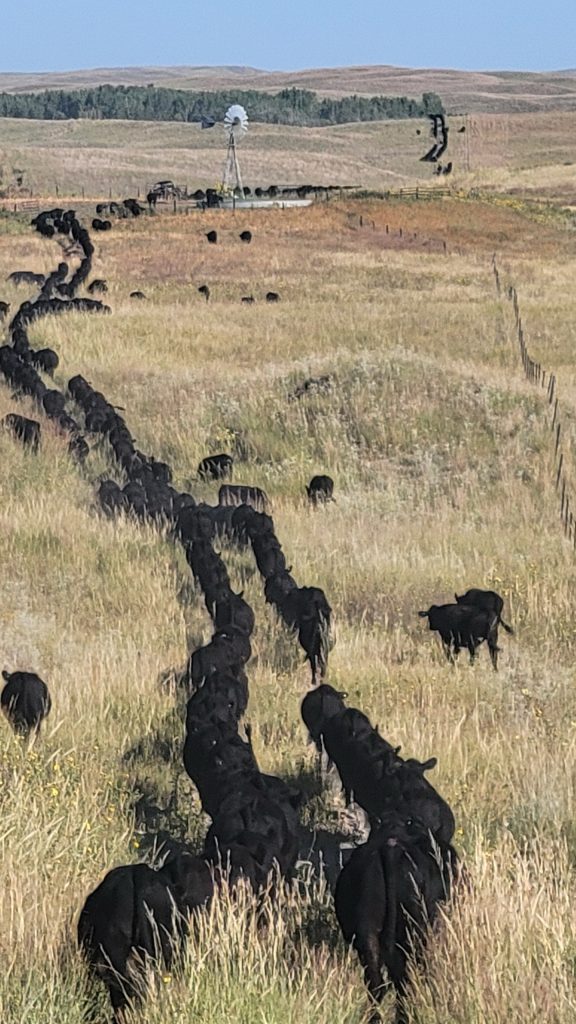
While the ridges of the Sandhills were blowing sand because of frequent fires, the draws, valleys and meadows however, were productive.
“Our ancestors said you could track a grey wolf from the North Loup River to the Dismal River (a winding 71.9-mile-long river in Nebraska) and they also mentioned clouds of mosquitoes,” Eatinger said.
His great-great-grandfather started out with 1,000 head but there was a certain amount of winter kill.
“Indians came down from the reservation and were grateful for the fresh beef. All parts of the cows were used even the hide and hooves — they didn’t waste anything. There was lots of admiration for the Native Americans,” Eatinger told The Fence Post.
His great-great-grandfather got the cattle shipped, driving them down the Platte Valley and loading them. Although he lost half the herd, for one reason or another including winter kill, he initially bought them for $5 each and sold them for $25 each.
“My grandfather told me, his granddad felt that this was his most profitable transaction, that first herd. He made $7,000 which was quite a lot of money then.”
They kept up that business, and managed to get to Ogallala. Then, another load of cattle came from Omaha that he ranged in Nebraska. The land all belonged to the government, although his great-great-grandgather knew what was going to happen with the settlers. He developed the grubstake (material assistance, like a loan to launch a business) and managed to put together land. He also talked people into coming there to also take out claims.
HOFFMAN RANCH
Another rancher in Cherry County, Jason Hoffman, of the Hoffman Ranch, lives in Thedford in nearby Thomas County, and leases 20,000 acres in Cherry County.
Hoffman and his family moved to northern Nebraska from northern California 17 years ago, where they lived in a small ranching community and sold bulls, and still have customers there.
“My dad was really intrigued by the Sandhills of Nebraska, and we knew if we were going to grow much in size, it probably wasn’t going to be where we were. It wasn’t as practical to run a cow as it is here in the center of the U.S.,” Hoffman said. Despite some windstorms that can blow the sand, Hoffman said, if the grass is managed right, it usually all works out.
It’s all about location and with so many cattle around, it fit their business model well, in addition to other benefits including the grasslands, water and the people in northern Nebraska.
With 20,000 acres, Hoffman has a large herd. They sell Hereford and Angus bulls, hold two bull sales every year in November and February, and have a female sale. They grow their silage under pivots. The hills are strictly for the cows.
It’s a family operation with Hoffman, his wife and three children.
“It’s nonstop, and everything is targeted for those two sales. My folks, who are in their 70s, are very involved. They have a lot of say, and I’d say there’s no way we could do it without them,” Hoffman said. Hoffman Ranch also has seven full-time employees who help with their three different ranches. They deliver bulls for free nationwide, they stand behind them, and have competitive guarantees on their bulls, with quality first, Hoffman said.
Hoffman’s dad started their herd with his love for the cattle he grew during 4-H. His wife’s side is their sixth generation of ranchers, and has family who live in northern Nebraska.
The family sells seedstock, conducts artificial insemination with their bulls, and helps market commercial cattle for customers. They also show bulls at the National Western Stock Show in Denver, as a way to promote cattle.
“My kids are into it, my son enjoys calving and the business and science part of it, they’re involved in 4-H and FFA, my two daughters like the horses and cattle, and showing the heifers,” Hoffman said. “I think it’s all a pretty good vehicle to teach them a work ethic,”
I like Cherry County, because it’s a good place to raise kids and cattle. The good definitely outweigh the bad days. I think it’s a good part of the world,” said Hoffman who was on a livestock judging team while attending Kansas State University.
No two days are ever the same and late springtime is especially busy.
“I left at 5 this morning to get bulls taken care of, and now back at the ranch we’re going to sort a bunch of cows, and ship some cows, and sort tomorrow’s loads of bulls. We were also calving and branding calves, and synchronizing cows to breed again,” Hoffman said about how busy it is in late April.
It’s an enjoyable time of the year when the weather cooperates.
Cherry County ranchers have a special sense of pride, are steadfast and value the ranching lifestyle on their vast homes on the range.
“It’s cool to be in agriculture and there are so many jobs that correlate to agriculture,” Hoffman said. “For the most part, my family doesn’t have a whole lot of wants and needs to do much else, than what we’re doing,” he said.