Recounting devastation in Wyoming winter of 2022-23
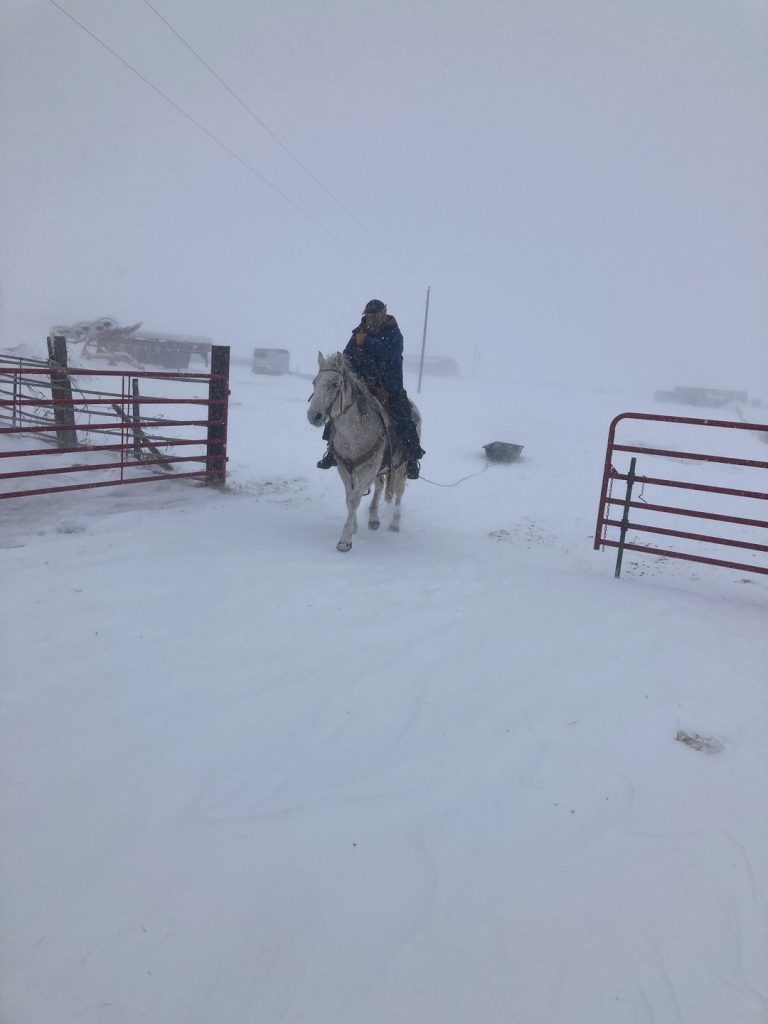
“There has been no relief from the weather,” Wyoming Gov. Mark Gordon stated in a disaster declaration submitted to the federal government on March 6, 2023.
“As recently as last week, another storm dropped upwards of 4 feet of snow across central Wyoming, coupled with sustained extremely low temperatures. This is just one example from one recent storm, and this weather event impacted the entire state of Wyoming with snow and cold conditions. Wyoming leads the nation by being under some combination of Winter Storm Warnings, Blizzard Warnings, Winter Weather Advisories, and High Wind Warnings at a total of 66.5 percent of the time from Jan. 1 to Feb. 27. The compounding impacts of these events, starting Jan. 10, 2023, have been drastic.”
Old-timers and young ranchers alike agree that Wyoming’s winter of 2022-23 may have been one of the worst in memory. In total snowfall, Riverton, Buffalo, Midwest, Bedford and Afton all broke previous National Weather Service records to make 2022-23 their snowiest winter on the books, and Casper put their third heaviest snowfall record in the books.
Cowboy State Daily reported that Casper hit -42 degrees on Dec. 22, 2022, possibly setting a record. On Feb. 23, Cheyenne hit -19, setting the record low for the city, and 4 feet of snow fell at Battle Lake in Carbon County, about 25 miles south of Rawlins.
USDA FSA REPORTS
Livestock losses also topped the charts.
Deena McDaniels is a program specialist currently working in the Wyoming state Farm Service Agency office. She described the winter of 2022-2023 as “the perfect storm.”
“All of us who live in these places are aware of what winters can be like and we’re pretty prepared,” McDaniels said. “Last winter we had pretty significant snow and wind with back-to-back storms starting the end of December and going through April. It seemed like the wind never let up.”
Ranchers were plowing snow for months; plowing snow to feed their livestock, plowing their way back home after they fed.
“In many instances they weren’t shutting their equipment off because it was so cold they were afraid it wouldn’t start again if they did,” McDaniels said. “Feed expenses were huge this year as were equipment expenses as producers moved snow and kept livestock fed.”
Livestock losses were staggering, and continue to be tallied as applications for USDA programs such as the Livestock Indemnity Program (LIP) and Emergency Assistance for Livestock, Honeybees and Farm-Raised Fish Program (ELAP) are just now being completed.
As of Jan. 1, 2024, Wyoming livestock producers had reported the loss of 8,600 beef calves of all sizes, 1,740 adult cattle including cows and bulls, 3,400 adult sheep and 850 lambs. Losses of 257 nanny goats and 41 kids or slaughter goats were also reported.
FSA programs are not designed to reimburse producers for the loss of unborn calves and lambs, or productive lifespan of an animal.
“That does make mortality loss that much more significant,” she said. “We do the best we can for producers within the parameters of the programs. We got lucky and didn’t lose as many lambs as we have in some past winters when big spring storms hit, as lambing season hadn’t fully started.”
Finding the full impact of the devastation has been a long process. LIP and ELAP payments have started to go out to impacted producers.
“So far, for applications that have been processed, $7,371,000 in LIP payments has been distributed, but these are not totals. ELAP payments $14,795,000 to help cover the costs of operating heavy equipment and excess feed have been sent to producers to date. We’re not finished,” McDaniels said.
It was not uncommon for larger operations to report losses over 100 head.
“These programs are here to help producers mitigate disasters and keep them on the land, but they are not meant to make producers 100% whole again,” she said.
McDaniels moved from working as county executive director of the Natrona County FSA office to her current position in the state office last May, following the disastrous winter. She said that she personally observed different agencies within and between counties working together and providing mutual aid to try to keep roads open.
“Without a doubt I believe that every effort was made to do their level best,” she said.
WYOMING DEPARTMENT Of AGRICULTURE
Derek Grant, Public Information Officer in the Wyoming Department of Agriculture said that one of the biggest complications of the winter of 2022-2023 was that temperatures stayed cold, winds did not abate, and they did not have periods of snowmelt typical to most winters.
“Usually we get a nice warm up between storms,” he said. “Last winter was brutal.”
“In a lot of circumstances, when producers are asking for help they reach out to their county emergency manager,” Grant said. “That’s the first line of defense, and that is who we end up talking with to facilitate anything we can to help in those circumstances.”
Once WDA Director Doug Miyamoto was in contact with emergency managers in Wyoming counties, the department “worked closely with as many people as we could,” Grant said.
“We listened to producers, and reached out to the Bureau of Land Management and Farm Service Agency seeking innovative responses to help. Both responded well.”
Grant described snow removal as an “uphill battle. By the time we got a road cleared it got covered again. It was a constant battle.”
Gov. Mark Gordon stated in his disaster declaration: “The winter season started early, and producers were forced to commence much higher levels of supplemental feeding and will need to sustain these operations for a longer period than during any winter in recent memory. Feed resources have been limited and expensive as well, compounding the problem and resulting in significant increases in costs for producers.
“Many herds have been trucked out of traditional winter grazing areas and closer to their respective home places to maintain contact, but access by truck due to drifting snow and road closures is hampering efforts to reach and remove remaining livestock. Snow removal has become a critical operation to keep animals alive. Access to traditional winter grazing resources has become dire as well because many ranch, county, and BLM roads are drifted shut and, even when cleared, continue to re-drift because of high winds. Mortality has been high thus far and is expected to increase well into the spring as a result of this exceptionally harsh winter.
“State, county, local, and individual resources have been deployed throughout this event and are being shared between entities for snow removal, but there is too much volume and wind to keep roads open and passable to gain access to livestock.”
Grant said that the WDA worked closely with USDA.
“They opened up programs such as the emergency livestock assistance program and the livestock indemnity program, as well as others to help producers with additional costs due to feed purchases, snow removal and fuel. Once the disaster declaration went through, the USDA opened up low interest emergency loans for livestock and forage.”
Grant said his office encouraged people to get in contact with their local FSA office for assistance that was available to help ease some of the costs incurred by having to start feeding sooner than usual and hiring snow removal equipment.
“I know it was tough, lots of livestock producers were severely affected,” Grant said. “One thing I know is that we have a very resilient bunch of producers here in Wyoming. It’s a tough business sometimes but we have the most hardworking, creative and resilient livestock producers in the country who can fight through situations like this and find their way to the other side.”
Looking at both funding and snow removal resources, Grant said it was a statewide problem, with Carbon County probably getting hit hardest.
“We were well aware of the situation and very sympathetic to everyone dealing with the difficulties last winter,” he said. “We did everything in our power to help, and we’re continuing to do everything we can to help our producers recover. Unfortunately, we learn too many times that weather events can be beyond our power to combat.”
A COUNTY COMMISSIONER’S PERSPECTIVE
John Espy, Rawlins, Wyo., cattle rancher and Carbon County commissioner described the winter of 2022-23 as “Just unreal. When elk and wild horses start tipping over, you know you’ve got a tough one.”
“Usually when we get a bad winter it might affect a different area of the state: east, west, north, south, but not the whole thing. What was strange about last winter was how far it consumed the I-80 corridor: all the way from Point of Rocks in Sweetwater County to Arlington in Carbon County, a distance of over 140 miles.”
He doesn’t know how many inches of snow fell last winter.
“We figured it at 200% of normal,” he said. “We had an inverted snowpack; below 8,000 feet elevation we were at 200% snowpack, above 8,000 feet it was about 125%, so we had more snow at lower elevations, not higher elevations.”
Espy said the last time they experienced a winter anything like this was 1983-84.
“It started early, and just hung on and hung on and hung on,” Espy said. “It didn’t break until April. On a personal note, we thought things were starting to break mid-March. The county was starting to open up some roads. We snowmachined in to our ranch and walked the dozer out so we could start plowing in. It took 30 days. It was April 20 when we finally dozed back in to ranch.”
An additional factor that made it tough for livestock and wildlife alike was a drought the previous summer.
“There was no feed on the ridge tops for anything,” Espy said.
Assistance for ranchers in Carbon County needing to be plowed out due to weather emergencies is usually handled on a ranch by ranch basis.
“Ranchers get in touch with our Road and Bridge department to coordinate plowing in feed or fuel, or getting livestock in or out,” he said. “When somebody made a request, we tried to coordinate to get assets to them, to get into some places we even contracted with private contractors. In the north country, it was tough last winter even to get assets out there, as it would blow in behind them as they were plowing.”
Espy said that it was “physically impossible” to keep roads open. The uranium mine ended up running employees in and out on snow cats. They hired one contractor who brought in a D10, and could only make three miles a day.
Espy does not believe anyone was negligent, from ranchers who lost stock to state and county agencies who were asked to help.
“It was a frustrating situation, sometimes we couldn’t even get on the state highway to get to the county roads to get to people,” he said. “In one event, all of WYDOT’s trucks were stuck, and the highway department let private contractors plow down the interstate for shift change at the refinery, that was how bad things got. It was only five miles but it was impassable.”
In another instance, the state responded to a power outage at Bairoil North with a special refitted military all terrain machine.
“They brought in a Hagglund, a military vehicle made in Germany for NATO, from 10 miles north of Saratoga. There’s an outfit in Casper that converts them for civilian use. They ran power crews all the way out there, and had to do minor repairs on it at Muddy Gap to get it home, but they were picking up people as they went. We had people snowed in in the oil fields in places.”
“It was just brutal. To my knowledge we only had three bunches of livestock in our county that were in super trouble. By the time people realized how bad the situation was it had already hit the tipping level; some people were almost in survival mode by then. With the situation so dire, we were just trying to get what we could in to them.”
Carbon County officials had to get permission from the BLM to traverse federal lands.
“They were very good to work with last winter in situations when we had to leave county right of ways for health and human safety,” Espy said.
Espy said that as far as state road maintenance, there were sufficient trucks but a shortage of drivers, but he wasn’t sure what else the state government could have done.
“They couldn’t even keep their highways open.”
As for his own livestock, Espy said, “We made the winter OK, and then hit some toxic plants in the spring. There was no old feed mixed with the new growth as the cows were pulling out of the winter feed ground, so that was a frustrating loss for us.”
WILDLIFE LOSSES
Breanna Ball, Wyoming Game and Fish Department communications officer said that the department is currently still in the process of compiling and evaluating recent data to fully assess the wildlife populations across the state.
“It’s quite a complex process; we are currently analyzing our counts for most of our units for deer,” she said.
Pronghorn and elk numbers are still being tallied.
The Wyoming Range mule deer herd took a significant hit, Ball said. This is the only completed herd evaluation at the time of this writing.
“That herd was reduced to about 11,000, down from roughly 30,000 at last count one year prior,” she said. “It was hit harder than other herds in other areas of the state. There are a few factors that can play in to losses besides the weather; body fat scores going into winter is one. For pronghorn, pneumonia is also a factor that can lead to high mortality rates.”
Game and Fish biologists and wardens wouldn’t typically conduct intensive aerial surveys two years in a row due to the high costs and flight time involved, but given the unprecedented winter of 2022-23, the department decided it was important to obtain an accurate and full picture of this herd’s population.
Ball said that herds on the western side of the state took the hardest hit from the weather. They are also reviewing mortality data collected from 1,000 collared mule deer across the state.
Elk also suffered.
“We have 21 elk feeding grounds across the state,” Ball said. “We feed elk for a variety of reasons: to minimize destruction of livestock feed sources, keep them off cattle feed lines, and reduce brucellosis transmission. We did some emergency supplemental feeding for elk last winter, and we did see higher than normal elk mortalities in some areas of the state.”
FERRIS MOUNTAIN RANCH
Gary, Judy and Kenny Raymond typically don’t have to feed very much hay to their cows through the winter, but are able to rely on reserved pasture grazing as their main feed source. Ferris Mountain Ranch, about 40 miles north of Rawlins, Wyo., is a combination of high desert and mountain country. This is the Raymond family’s 75th year on the ranch.
“We have native sagebrush country and sand dunes, and the Ferris Mountains, with the highest peak at 10,200 feet, where we put the cattle in the summer. Our houses are located at 6,850 feet, so we are pretty high altitude.”
They average 9 to 11 inches of moisture per year.
“We calve later, toward the end of May and into July, and our cattle have been able to graze all winter for many years. It takes extreme circumstances like last winter for our cattle to need hay.”
While the early part of the winter seemed pretty normal, in January, the blizzards started hitting.
“We got cold, cold temperatures and the wind didn’t let up; it was another blizzard and another blizzard and in between it was so cold that none of the snow could melt. It just packed in. By the end of March it was brutal. There was no feed that the cattle or wildlife could get to. We seemed to be right in the bullseye.”
Judy Raymond said that it did not let up until mid-April. Some of their cattle were grazing on BLM land several miles away from ranch headquarters.
“We could not get to them even to check, until we bought a snowmobile,” she said. “We couldn’t have gotten them home; there was too much snow and too many drifts, and the BLM wouldn’t have tolerated a dozer going out there for miles and miles to make a path.”
“On private land, we can legally take a bulldozer around anywhere we like, but that is not the case for our BLM allotment where much of our winter grazing was reserved,” Gary Raymond said. “Had the locations of those cattle been on private, even then the difficulty and expense likely would not have been logistically or economically feasible. Thirty-seven degrees below zero, howling winds, and the deep, drifting snow had already taken a lot out of those surviving cattle.”
Even if they could have gotten feed there, Raymond said that it might have made the situation worse.
“Even if we’d had access to certified weed-free hay (which is a federal regulation on BLM-managed lands), the problem of rumen stasis trumps the decision to feed. A quick belly full of dry hay without access to plentiful water is a near certain death sentence. A snow bank is just not enough,” Raymond said.
Raymonds’ hay is not free of weeds, so when they feed cattle they do their best to keep off the BLM land.
“Many of the cattle that got stranded where we couldn’t get them to feed and water died,” Judy Raymond said. “The ones that survived we tagged differently. My husband says they must be ‘super cattle’ and have ‘super genetics.'”
Even cattle they got moved home perished. In all the family lost 361 head of cattle.
“We got some sorted off and brought to an area within a mile of our haystacks and the temperatures and wind were so hard on them that we lost some of them even though they were being fed,” she said.
Due to drought the previous summer, water sources were limited and that was also a factor in the losses of cattle that they were able to feed hay to.
Living with severe weather, droughts and storms are “part of the deal in agriculture; it always has been and always will be,” she said. “You plan ahead for it the best you can. We figure if God wants us here He’ll keep us here.”
The state highway department tried everything they could and brought in all equipment within reason,” she said. “The weather made it flat impossible to keep the highways open. I have no complaints about WYDOT’s efforts to keep roads open. It was a huge challenge.”
“Rocky Mountain Power Company employees in Rawlins, too, are heroes in our minds for the extreme efforts they made to keep the power on,” said Gary Raymond.
Hwy 287 was closed 23 out of 28 days in February, Judy Raymond said. She said that emergencies as severe as last winter are rare; this was the worst winter in Gary’s lifetime of 67 years.
“I would make a dash to town and just in the few hours it took to get groceries Hwy 287 was liable to drift shut. I stayed with our daughter for three days once because the highway was closed before I could get out of town.”
After conditions became too much for their 1960s D-6 Caterpillar, Raymonds resorted to a side-by-side with tracks and was able to travel back and forth over the four miles between the ranch houses and Hwy 287.
“The side-by-side with tracks turned out to be a blessing in ways we didn’t anticipate. We could get to some of the cattle with it, and if the conditions were right, the snow beneath the tracks would pack down firmly enough that we were able to trail some of the cattle down those tracks on foot and home. This also avoided violating any BLM surface disturbance regulations.”
Attempts to reach the cattle with horses and break a track were futile as the drifts were too deep.
“Since our cattle had become fairly well-adapted to our environment, we had been successfully grazing through the winters for decades with good results. Our winters are pretty harsh even in an “average” year, but there’s always the risk of a winter like ’22-’23 that tests the hardiness of even the most resilient native animals, such as elk and bison.”
Gary Raymond said that they chose not to utilize any of USDA’s risk management programs.
“The Lord provided help in many ways, including some friends who offered financial help, prayer and encouragement.”
Gary Raymond’s go-to verse is Isaiah 26:3: “Thou wilt keep him in perfect peace, whose mind is stayed on thee: because he trusteth in thee.” Still, Gary and Judy feel that it is incredible that many of their cattle survived the conditions they experienced, especially the last two blizzards of the spring.
“Most of our cattle that were grazing out were doing okay until then. But even after those two blizzards, there was a remnant of those cattle that survived, though few. Those are the ones from which we hope to rebuild, as they may have the epigenetically derived genes of hardiness and adaptation similar to those of the indigenous ungulates. There’s no doubt that there’s something special about those survivors.”
A DIRE SITUATION
Cork Meyer felt like he got the run around by local and state government offices when requesting assistance for his in-laws, Jerry and Mary Jo Faddis.
“We got absolutely no help from the government here,” he said. “They were not willing to come out north of town for nothing. The commissioners denied doing anything, and the governor’s office said they couldn’t deploy the National Guard without Homeland Security approval.”
Meyer felt that ranchers got the short end of the stick, saying that the county opened roads to tourist destinations and gas properties.
“I’m not against that,” he said. “Road and bridge hired contractors to go to Seminole Park to get people out. A ranch out there got opened up when they had the dozers out. I think everyone could have been plowed out.”
Meyer said he kept his in-laws’ road open to the best of his ability, and his wife and her sister were able to get medicines to their parents via snow machines.
Eventually the snow covered the stackyard fence and Faddis’ cows got into the hay supply.
“He had 300 tons of hay on hand, and bought some more after the cows got into it,” Meyer said. “Every time I got the road open so the trucks could get in, then 287 would be closed. Finally the truck drivers said they wouldn’t come because they couldn’t afford to get stuck here for 10 days. We were really in a catch-22 without government help.”
Meyer believes that Fremont County did a better job helping snowbound ranchers than Carbon County did, and feels the state should have stepped in.
“If they could do it in ’49 statewide, I don’t know why they couldn’t do a two county stretch here last winter.”
After Winter Storm Olive brought heavy snow, 70 mile per hour winds and severe cold in late February, Meyers said they could step off the snowdrifts onto the roof of the house.
“My father in law has spent 30 years building up his herd, and it just about killed him to sit there and watch them starve to death. It ruined him, he was just heartbroken. A lot of them died right around the house. We had 65 cows in one pile when we started gathering them up.”
Meyer said that Faddis lost over 100 cows, although they were not able to locate all of the carcasses. FSA paid him for about 80 head. Faddis also lost six saddle horses.
“He sold the rest of his cows and leased the place out this year,” Meyer said.
Meyer said he lost 20-30 head of his own cows, and then sold the rest, because they were drifting, trying to return to the place he had previously run on.
“The cows kept trying to go home through the storm,” he said.
Meyers also expressed concern for children who weren’t able to get home from school due to the closed roads.
“There were kids that had to stay with people they didn’t even know,” he said. “It was a terrible year.”
Meyers calls the 15 mile stretch of Hwy 287 from Rawlins to their ranch the “worst road in Wyoming.” He said the county got Ur-Energy to clear their road once, and a second time they came out at his sister-in-law’s request so an electrical pole could be replaced.
When he called about the highway being shut, he was told that the county was trying to get help out that way.
“They needed to try harder,” Meyers said. “No one cared, and they did not even seem concerned.” Meyer said the county abandoned roads north of Rawlins in a 20 to 30 mile span last winter.
“We live out here in no man’s land; nobody wants to do anything out here.”
He said the previous head of the Carbon County Road and Bridge “Would knock every road open north of town.”
Meyer said some people have shrugged off his concerns, telling him, “It’s your choice to live out there.”
But he said ranchers don’t necessarily have a choice in where their place is located.
Meyers is working with state Sen. Larry Hicks to draft legislation to help ranchers if this happens in the future.
“We need something that says they have to come help ranchers and they can’t abandon roads,” he said. “I’d like to get them to start a bill for next session. Let’s make a plan in case this happens to somebody else.”
Myers says there are “really good people” on the ag committee.
“I’m going to try this fall,” he said. “That’s all you can do.”
SHEEP LOSSES
“It was a very expensive year,” Marie McClaren said. The young rancher, with her family, operate Julian Land and Livestock in southwestern Wyoming near Kemmerer. Marie is the fifth generation of the Julian ranch to run sheep on the Carter Lease, following in the footsteps of her mother, Trudi, grandfather, Truman Julian, great-grandfather Don Julian and great-great-grandfather, William Julian. They also run several other bands of sheep on desert leases in the Rock Springs area.
“Our first big blizzard blew in the first weekend of January,” Marie said. “We started feeding the herd on the Carter Lease on Jan. 9, and we had to feed them through May. That meant we had to buy five months worth of hay; two more herds needed hay the majority of the time and two on the Rock Springs lease needed to be fed for a portion of that time.”
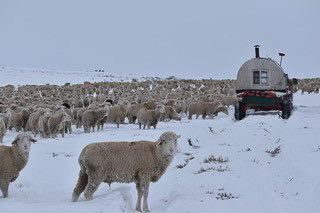
The Julian family runs sheep on desert permits where they are typically able to graze and browse on salt sage and sagebrush through the winters. While they may experience a few weeks or a month of weather where they have to feed hay because the sheep can’t get through the deep snow to feed, having to feed hay all winter is unusual.
“There was so much snow the sheep couldn’t get to feed anywhere,” she said. “We had about 4 feet of snow on the level at the ranch, and about 2 feet out on the Carter Lease.”
She and her mother worked in tandem, hauling hay on a flatbed and corn in a second pickup so that if one of them got stuck — which was a given — the other could pull her out.
“Every other day we put out two days’ worth of feed. We chained up all four tires on both pickups, but one of us still got stuck every time we fed.”

The snow had not yet melted when an April blizzard dumped approximately another 2 feet of snow on top of it.
“That was kind of what broke us,” Marie said. “It was really defeating to have 2 feet of snow come in April on top of everything we had.”
Losses were devastating. Around 800 of their sheep died, the majority in April with the big storm, shearing and freezing temperatures coinciding.
“We fed the herd on the Carter Lease all winter, and they maintained condition and did fairly well. When the storm came in April with a week of temperatures below zero, that was the breaking point for our herd. They started falling off really bad after that.”
The additional stress right before lambing proved detrimental.
“The storm just knocked them down,” she said. “When we started lambing in May the ewes were in such poor condition in spite of all the feed all winter that some didn’t have milk and others abandoned their lambs.”
“It’s much better this winter; we can see the sagebrush and the ground, and we haven’t fed a lick of hay to any of our sheep.” she said.
They had so much snow on their usual lambing grounds that they had to find different options.
“I was shed lambing about 400 head in March, and we had cows calving then too; we had to have a dozer come in and plow an area just to calve the cows.”
They opted to lamb one herd on the Rock Springs lease, where they don’t do as much predator control.
“Our death loss was huge for lambs down there,” Marie said.
Another added expense was due to the need to haul the ewes to new ground right before lambing.
“Normally we don’t haul our ewes anywhere; we trail them from winter country to lambing grounds, and then to summer country. Last year we hauled all of our herd to where they needed to go to lamb; we had to leave them on the desert country as long as we could to allow for as much snow as possible to melt on the lambing grounds before having to haul them there to lamb.”
“It was devastating; with the number of sheep we lost last winter after putting in so much time, energy, work and money.”
“It is hard, we do get depressed, and it does get really frustrating; there are times when it seems like everything is unmanageable,” she said. “The thing is, we’re resilient and we keep doing it because we love it.”
Marie felt that FSA did a “good job helping us financially,” and since they are in an area with oil and gas, roads were kept open.
“The guys who plowed the roads were good to help us if we needed to plow an area for the sheep,” she said.
CALVING LOSSES
Andrea and Thad Dockery ranch near Jeffrey City, in Fremont County, Wyoming. She still has trouble sleeping at night after the harrowing losses they experienced a year ago.
“It’s something I don’t ever want to live through again,” she said.
While it is typical for them to have snow, wind and cold temperatures through December, January and February, last spring the weather didn’t break until the second week of April. The area received 2 feet of snow in October, 2022, and while Dockery said it melted down, “it didn’t ever go away.”
Long before their cows started calving in March, they had to plow their way to feed the cows and plow their way back because the wind kept changing direction and the path blew in so fast.
Normally they feed with a pickup, wintering their cows with a combination of hay and grazing. They typically chain up the rear tires, but last winter required the 4-wheel-drive tractor from January through mid-April.
“We’ve never fed so much hay,” Dockery said. “From mid-December on what they got was what we gave them. They used every bit of it just to survive.”
Although they had purchased hay, they did end up needing to buy “quite a bit more” due to the harsh weather and the fact that all of their winter grazing was buried completely.
“In normal years, if we had fed that much hay they would have been looking like ‘farmer cows,'” she said. “These gals getting that much feed just to survive.”
Dockery said she was able to coordinate with the county to get the trucks in, unloaded and back out when the state highway was open.
“We live along US 287/WY 789, and the highway department said the corridor through there was worst in the state. Our daughter Rylee goes to school in Lander, about 50 miles from us. They run a bus from Lander out toward Jeffrey City, but due to the terrible road conditions, I had to move her to Lander to live with my parents on Jan. 3. She wasn’t able to come home full-time till April. That was tough. We had to coordinate with the highway department to go out on the closed road to get her home on weekends. So we had a lot going on besides just trying to feed the cattle.”
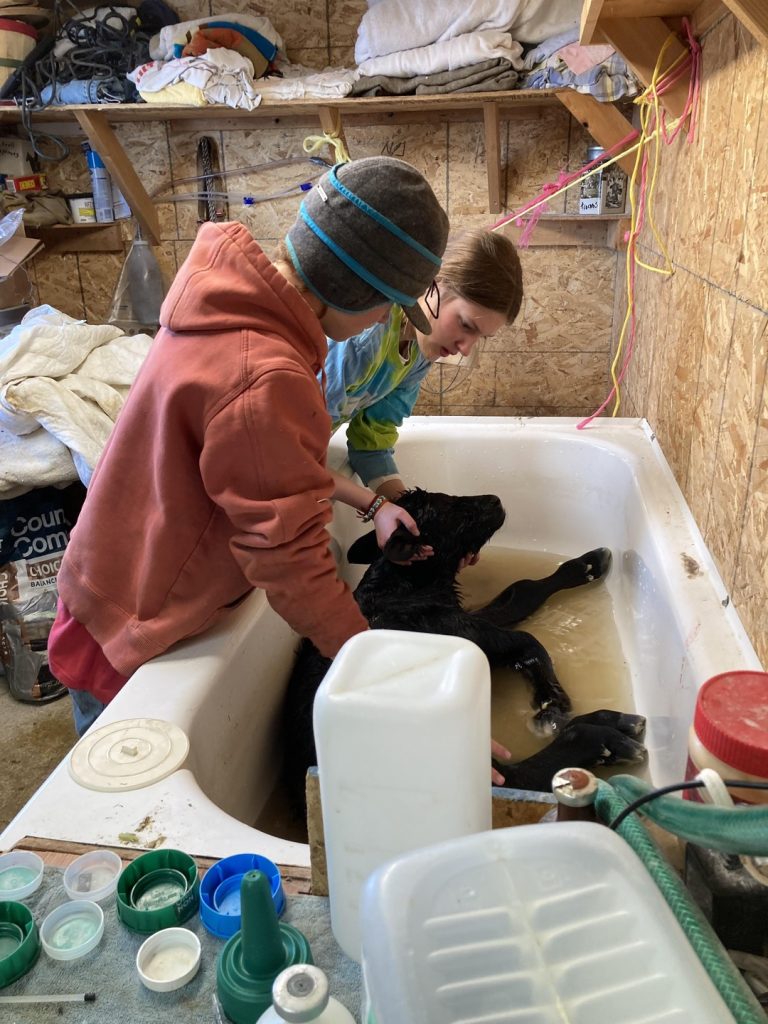
They even had to use the tractor for transportation.
“When our 19-year-old daughter Laura needed to head back to college the second week in January, we were completely drifted in. The county was busy elsewhere. We could not get out in any vehicle we owned, let alone Laura’s car. So Thad loaded Laura and her stuff up in our 4-wheel-drive tractor and headed to the highway, about five miles through the sage brush. My parents met her with one of their cars so she could get to school.”
Local ranchers compared the winter of 2022-2023 with the winter of 1978-1979, but Dockery said, “they didn’t calve in that weather. Winter broke mid-February in 1979.”
Dockerys’ cows were calving in windchills of -20 degrees F at night and -10 during the day.
“Calving was brutal.”
Their ranch straddles the Sweetwater River, with the yard on one side where they calve 2- and 3-year-olds and some old cows through the corral.
“Across the river we have a wonderful area to calve on the range,” she said. “We have sagebrush over 6 feet tall, so we have a lot of cover. Last March we couldn’t even see the sagebrush; there just wasn’t a place for them to calve.”
With the cold temperatures, when a calf was born he had less than an hour to live before he froze to death. Dockery estimated that they lost a fourth of their calf crop.
“I don’t know how many calves we found barely alive and did mouth-to-mouth CPR on,” Dockery said. “If we got them rescued, then we had to take the cow in, and it was straight ice, so we didn’t want to take a good horse out after them. Trying to get the moms to take the babies back after we had them for a while was challenging too.”
Dockery’s voice broke as she recalled the day her husband said to her, “We have to let some calves die because we’re going to kill ourselves if we keep this up.”
Going for 16 hours a day and getting up every two hours at night was taking a toll.
“Trucking around in knee deep snow, trying to pick up calves to get them in the tractor took some endurance. It’s a wonder we didn’t drop over with a heart attack.”
Still, it was “a tough decision. It’s a creature, and we do everything in our power to keep our cattle alive and healthy,” Dockery said. “
When Rylee was home over spring break, they found her in the vet shed at 11 p.m. where she had fallen asleep trying to keep a calf alive. Laura came home from college over her spring break to help on the ranch too.
“Thank God for their help,” Dockery said.
The family lost a few cows and a “handful of yearlings” as they keep their calves over after they wean them.
“One day after the wind switched directions, we found a yearling steer that died standing up.”
Dockery can’t shrug off the losses.
“We cherish each and every cow we have. If our animals are hurting or sick we do everything we can to fix the problem. A lot of last year’s calves that are yearlings now have no ears or no tail, but they are alive.”
The family continued finding dead calves into June as the snow melted.
“It got to the point where you didn’t want to go out,” Dockery said. “Thad would come back from checking and say, ‘Well, the good news is there’s four live ones.’ And I’d respond, ‘And…?’ ‘And there’s four dead ones,’ he’d say. At least the babies weren’t all dead.”
She felt guilty even being in the house.
“You can’t live with the ones in the pasture. It was so tough. Doing your best is all you can do, and it wasn’t enough to save them.”
This winter has kept Dockery on edge. Last fall, locals said the Old Farmers’ Almanac was predicting another bad winter for them, and even though it didn’t materialize she has felt the stress of worry.
“It 100 percent feels like PTSD. Every day, I have wondered ‘what does tomorrow hold?’ ‘when is it coming?’ At night, I hear the wind blowing and can’t sleep.”
She still gets emotional remembering the losses, but is starting to get to the point where she can talk about it without crying.
“Ranching is not for the faint of heart,” Dockery said. “People think of the romance of ranching, or the romance of cowboying, but there’s no romance when it’s like this. You have to have a real love and passion for the cattle and the life; this is more than a job, this is our life.”
BLIZZARD POEM
February Blizzard
By Marie McClaren, 2023
The wind wakes me at 3 a.m.; it sounds as if it’s going to blow the roof off my house.
I lay there listening until I get up at 5, praying to God it doesn’t destroy what we just plowed.
I leave the house in the early morning, like every day before.
Except this time the road is drifted in, for the plows couldn’t make it this morn’.
The highway is closed with several inches of snow, and the wind is blowing fierce.
I cannot see anything but white and fast moving snow, and oh man my eyes are pierced.
I make it to our other ranch to feed, and drive out with hay to find the sheep.
The tractor barely makes it through the dense drifts, where I find the herd buried in snow, belly-deep!
The ewes won’t leave their huddle; they are hunkered down for the storm.
But I fed them down by the shop for some cover, where it may be a bit more warm.
When they don’t come to meet the tractor, I walk over to meet them instead.
It is in this freezing moment that I wonder why we all just didn’t stay in bed.
Since they won’t follow the tractor, my dog and I try to move them through the drifts and blowing snow.
It’s not very far to the shop, but they don’t care to walk into the wind; and none of us can see, so we don’t know where to go!
About halfway, the poor gals stop and will only circle; at this point I begin to plead.
“I am your Good Shepherd, please trust in me, I am taking you to feed.”
I am getting awfully cold, and they either ignore my pleas or can’t hear them over the wind.
My eyelashes are freezing together, my hair and scarf are frozen solid, and my cheeks may be frost bit!
By the grace of God we finally make it to the hay, and I begin my trek back to the tractor.
I’m excited to be in the heated cab to thaw and finally out of the cold wind-chill factor.
I wait it out a while to warm up and see if the white out will clear.
But after a while of no end in sight, I decide to go so I’m not stranded here.
I can’t see, but I know my way; so I start my pickup out slow.
I don’t make it very far because blocking the gate is a 4 foot drift of snow!
I try digging myself out, but this doesn’t work; so I hook my pickup up to the tractor.
I pull it out of the drift and begin to plow the road that has drifted in since being here only a few hours.
I finally make it home, where I sit inside to watch it snow and blow, and dread what tomorrow will bring.
I am so thankful that I’m not lambing quite yet, and beg God to send us spring.
The next few days continue to get even worse…
-This poem is dedicated to all the ranchers who battled the never ending and brutal winter of 2023. You are strong. Stay strong. – Marie McClaren