Studs or duds

Jade Meinzer Follow

Audrey Powles
While this year’s calf crop is mostly on the ground, we ranchers are already preparing for next year’s crop. Ranchers play the long game. We make decisions a year in advance, most of the time with the goal of improving our herd with better genetics, more economical cattle and cattle that work for our environment. A crucial step in this management process is making sure that the herd bulls that we will be using are up to the task at hand. Bulls must pass a breeding soundness exam before they get turned out with their harem of ladies for the summer. It’s no secret that one of the largest expenses to a cow calf operation is an open cow. The cost of developing a replacement or purchasing a replacement animal can weigh on the bottom line.
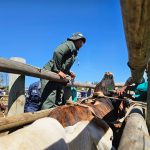
What exactly is a breeding soundness exam you might ask. There’s no private back corner of the barn with a specimen cup and a copy of Bovine Gone Wild magazine for the bulls to produce a sample for the vet to examine. The process is a little more hands-on if you will. The bulls are held in a squeeze chute so they cannot hurt themselves or anyone else during this process. The veterinarian begins the exam by checking out the bull’s family jewels. He’s looking for any signs of trauma, cold stress or any other indicators that might produce a sterile subject. He then measures scrotal circumference to give an indication of the bull’s maturity. The vet then dons a shoulder length plastic glove and performs the equivalent of a prostrate exam to ensure the internal components are in working order. He can feel abscesses, growths and other issues during this stage.
Now comes the part that should have been featured on one of those Dirty Jobs TV shows. Some poor vet tech or vet student that tagged along with the vet for the day gets to man the rocket. The rocket is a large probe that goes into the exit if you will and uses a series of electric pulses to stimulate the vesicles and cause the bull to produce a sample of his swimmers. One should note that this poor vet tech is usually dressed in rain gear from head to toe and will be covered in foul smelling excrement by the end of the day. It’s best that these individuals don’t carry on a conversation during the test, tight lips might prevent an unwanted taste test. Ranchers, please don’t feed your bulls an extra charge of silage or alfalfa hay before test day. The vet tech will thank you.
With the swimmers collected, they are put under a microscope and evaluated for morphology and mortality, basically the number of live and healthy swimmers versus the dead and deformed ones. A bull needs to pass both tests to pass his fertility exam. No one really wants to turn out a bull that is loaded with blanks. When the test is complete, the bull is released to go back to his pen for a nap while the process is repeated. By the end of the day the bulls are a little more mellow, the cowboys are tired, and the vet tech looks like some new form of abstract art. It’s a part of ranching that isn’t glamorous, but one that needs to happen to protect the herd for the next generation.
That’s all for this time, remind your vet to warm his hands up as a courtesy to the bulls and give the poor vet tech an extra slice of dessert on test day. Keep tabs on your side of the barbed wire and God bless.
Meinzer is a fourth-generation rancher raised on the southeastern plains of Colorado. He and his family live and ranch in Oshkosh, Neb.