Sugar growers fear loss of school sales
Sugar-RFP-020226
INDIAN WELLS, Calif. — Sugar growers, already beleaguered by low prices and a global oversupply, are worried that application of the Trump administration’s Dietary Guidelines for Americans could lead to a massive reduction in government purchases for school meals, industry officials said here this week at the meeting of the American Sugarbeet Growers Association.
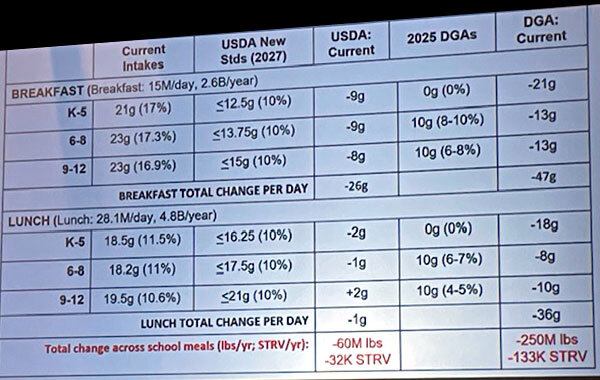
Government food programs including school meals are supposed to follow the dietary guidelines, and if the new guidelines announced earlier in January are followed that could mean a reduction of between 60 million and 250 million pounds of sugar for school meals each year, said Courtney Gaine, president and CEO of the association, which represents the industry on scientific and technical issues.
“If the administration pursued rulemaking to align the National School Nutrition Standards with the 2025-2030 Dietary Guidelines and completely eliminated added sugars from school meals for children under 10, this would impact an estimated 1% of current demand, but more importantly it would not be based on science and would not advance the goal of improving children’s health,” Gaine told The Hagstrom Report.
“Real sugar is real food, and it plays necessary roles in many common recipes that deliver nutrition at every age — for example, balancing sourness in yogurt, keeping sauces from being too acidic, balancing bitter taste in whole grains and fiber, feeding yeast that makes bread rise, and more,” Gaine added.
About 30 million children eat school lunch each day, and 14 million eat school breakfast.
Health and Human Services Secretary Robert F. Kennedy Jr. has said “sugar is poison,” Gaine noted. While the dietary guidelines do not call for zero consumption of sugar or other sweeteners, they do recommend limiting sugar to 10 grams (2.4 teaspoons) per meal, avoiding sugar in infancy and early childhood including no sugar between the ages of 5 and 10 and again avoiding added sugar between the ages of 11 and 18 including sodas, fruit drinks and energy drinks. Full-fat dairy products are recommended, but with no added sugars.
But exactly how the Agriculture Department will apply the new dietary guidelines to school meal nutrition standards is unclear, Gaine said. “The guidelines leave a lot up to interpretation,” such as how “avoid” will be interpreted, she said.
“There is a lot for interpretation, but the rhetoric is not positive,” she added.
“The dietary guidelines’ theme of ‘Eat Real Food’ fits well with sugar, but added sugars are not considered real food,” Gaine said. That view runs counter to science, Gaine said, and the Sugar Association is preparing ads pointing out that sugar is “real.”
The dietary guidelines could also affect what foods are allowed under the Special Supplemental Nutrition Program for Women, Infants and Children, which feeds about half the small children in the country, Gaine noted. Agriculture Secretary Brooke Rollins has also said the dietary guidelines will be used to adjust what foods are fed to the military and to people in federal prisons.
The Make America Healthy Again Movement — which backed Kennedy in his run for president, encouraged people to vote for President Trump after Kennedy dropped out of the race, and propelled Kennedy to secretary — “is a popular movement, and people are acting like soldiers in it,” she said.
People who work at The Sugar Association received a death threat, Gaine noted.
A poll showed that a majority of Americans and even more MAHA supporters believe that “real sugar fits into a healthy lifestyle and balanced diet,” Gaine said. Another poll showed that 88% of MAHA supporters believe that “real sugar can play a role in the movement,” she added.
Sugar consumption could also be affected by the Food and Drug Administration’s plan to update the definition of the term “healthy,” she said.
The Sugar Association will monitor developments at the federal level and also try to tell the public that “sugar should and can be consumed in moderation as part of a balanced diet” and that sugar “comes from plants and is ‘real,’ unlike alternatives,” Gaine said.
“So few people, including Congress, know the facts,” she concluded.