Won’t buy discolored meat? You might be adding to significant global waste
Beef1-RFP-011926
Each year, about one-third of the food produced globally is lost or wasted — a staggering statistic given the increasing demands to feed a growing population and the strain on water, labor and other critical resources needed to produce food worldwide.
The waste amounts to an estimated 429 million pounds each year in the United States alone, and there are many factors contributing to the problem.
Meat is a particular concern because it’s perishable and is generally more resource intensive to produce than other types of food. Mahesh Nair, associate professor of animal sciences in Colorado State University’s College of Agricultural Sciences, is focused on solving one aspect of this wasted-meat equation: beef that is discolored, not spoiled, but is nevertheless discarded from grocery stores and homes.
“I hope by the end of my career I’ll have made a real dent in this,” said Nair, who has researched this topic extensively since arriving at CSU in 2017.
SAFE TO EAT
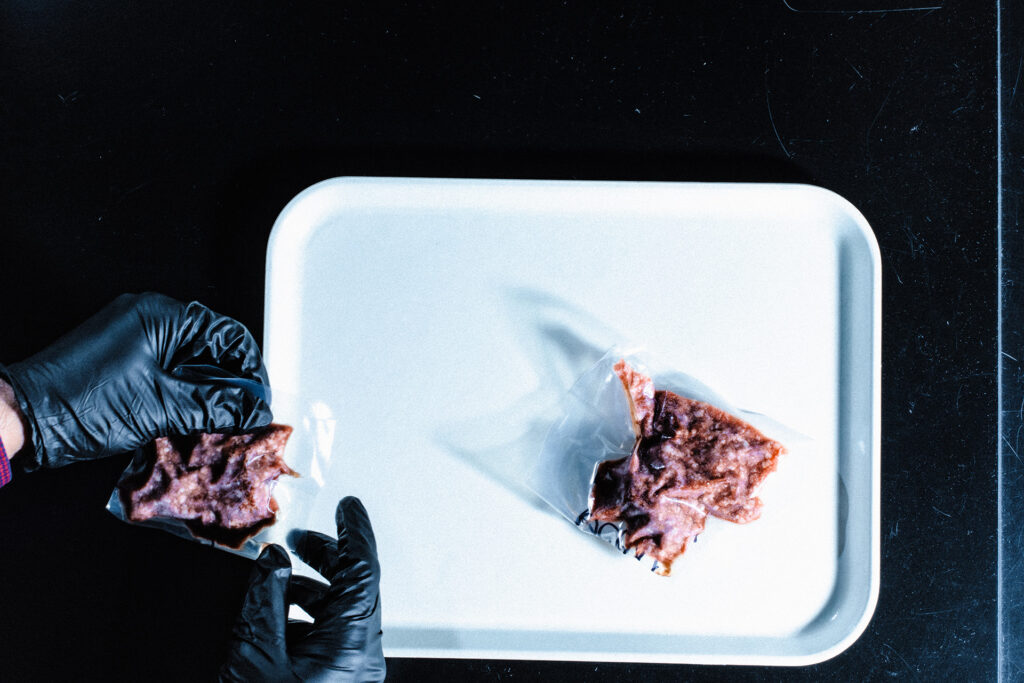
Consumers, particularly in the United States, prefer products such as steaks and ground beef that have a bright, cherry-red color; they tend not to buy meat that is at all brownish, even just in spots. The problem is that most slightly discolored meat remains safe. However, because consumers won’t buy it, stores will either heavily discount the meat or throw it away altogether.
“This is a major challenge, and retailers are really starting to recognize this,” said Scott Howard, director of quality assurance and process improvement at Meyer Natural Foods in Loveland. “Having people like Mahesh working on the science and, more importantly, understanding consumer perception, is critical to solving this problem.”
In a recent study in which Nair was involved, the authors estimated that $2.55 billion is lost annually due to discolored meat being discarded from retail stores in the U.S. They estimated another $1.18 billion is lost due to stores needing to discount prices.
“That’s really the challenge — that this discoloration can start before the meat is actually spoiled,” Nair said. “Color alone is not an indicator of spoilage. But stores won’t take the chance; they don’t want to have a bunch of brown meat sitting in their case.”
Consumers who are concerned about deciphering whether meat has gone bad, Nair said, should focus on odor and slime: If the meat smells bad or is slimy, it’s not good to consume.
SEARCHING FOR A SOLUTION
Over the years, Nair’s work on this topic has focused on three main areas: surveying consumer habits and preferences, investigating options for alternative packaging, and better understanding the role bacteria play in meat spoilage and discoloration. All three, he said, could help reduce food waste.
Nair has conducted multiple consumer-preference studies to learn more about what might influence shoppers to purchase meat that is slightly discolored.
Overall, Nair said, studies show that 20% discoloration on the surface of a steak will cause consumers to begin to consider another option; at 40% discoloration, consumers likely reject the meat altogether. Another challenge, Nair said, is that some steaks will brown more quickly than others; for instance, a tenderloin browns faster than a New York strip.
Notably, Nair said, in a recent study, nearly all the consumers who participated indicated they would consider buying a discolored beef steak after someone explained that color alone is not an indicator of the quality of the meat or whether it is safe to consume. Nair has also found in studies that men tend to be more forgiving than women when it comes to purchasing slightly brown meat.
“We really want to understand what is driving these purchasing decisions so that we can consider how we can better educate consumers,” Nair said.
Altering how meat is packaged is another option. Exposure to oxygen, which interacts with a protein in the meat called myoglobin, leading to its oxidation, is part of what causes meat to brown. Vacuum packaging can help delay the effect.
This type of packaging is more common in Europe, but is not widely used in the U.S. The beef industry, Nair said, is hesitant to adopt something consumers might not be familiar or comfortable with.
Moving away from the traditional overwrap Styrofoam tray packaging used on most ground beef, Howard said, would greatly improve the situation, helping not only with financial losses but also with industry efforts to become more sustainable. “There is no single thing we could do that would have a bigger impact than this change that Mahesh is investigating,” Howard said. “I’m fully convinced of that.”
Nair is also conducting experiments in his lab at CSU to better understand whether there might be a way to manipulate bacteria to delay the browning process. “One of the bigger projects we’re doing right now is trying to better understand the relationship between bacterial growth and color,” Nair said. “We used to treat bacteria and color separately, but our data is showing there’s crossover. This might be an area where we can move the needle on discoloration, and we have several follow-up studies in the pipeline.”
Nair is also in the process of collaborating with the National Cattleman’s Beef Association to conduct a nationwide consumer survey on these topics to dig further into consumer preference and behavior.
“There’s a lot of interest in this topic,” Nair said. “Whenever we talk to industry leaders, they all want a solution.”