Meat Pods could be a processing option for rural communities, producers
Pods1-RFP-100526
A group of ranchers in Nebraska is working on bringing meat processing and sales back to local communities in order to improve profitability on the family ranch.
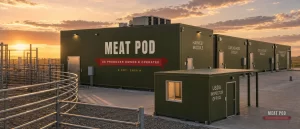
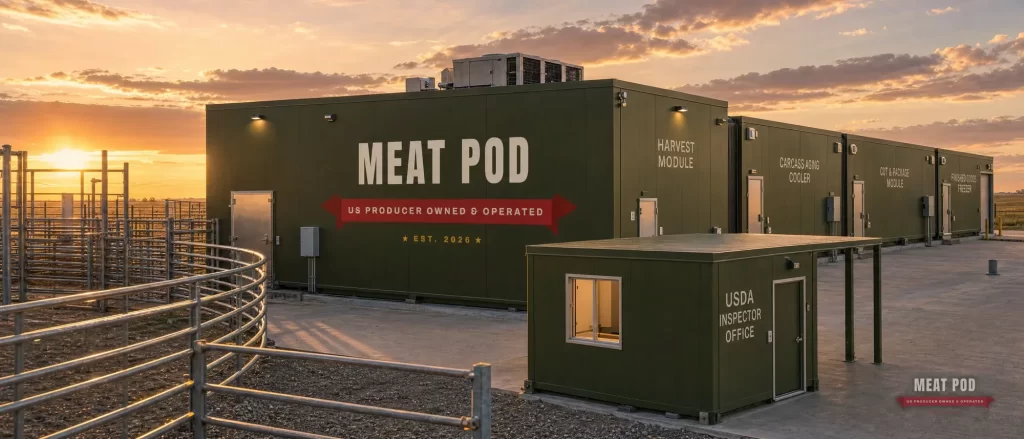
Through their new project Meat Pods the Nebraska Farmers Network is offering ranchers an opportunity to have an on-site beef processing station, a Meat Pod, that would allow them to process their beef into wholes, halves and quarters before being sent to a regional packing house.
Each Meat Pod will consist of a beef processing floor in specifically designed cargo containers that can be fitted together at a property to make an exterior knock pen and knock box, a draw-down cooler and a carcass aging cooler with up to 58 head hanging capacity. Each Meat Pod will also include a cutting and packaging station and a finished goods freezer can also store over 46,000 pounds of product. The Meat Pod is designed to allow for processing of 15 head per day.
FIRST MEAT POD
The first Meat Pod is currently being built and is set to be completed in the next three months. The price for each pod is in the process of being determined by the manufacturer, but NFN notes that much of the cost can be covered through Small Business Administration and U.S. Department of Agriculture loans.
“Most owners can finance the large majority of it through SBA and USDA-guaranteed loans, processing grants, and equipment financing, with our in-house grant and SBA specialists doing the work. Meat Pod introduces lenders but does not finance pods directly,” the project website, meatpods.com, noted.
Once a ranch has a Meat Pod built on the property, ranchers can choose to opt into the NFN Meat Pod franchise that will help them deal with many of the operations aspects of the processing business.
“Buy a pod outright and the plant is yours with no royalty and no system to follow, but so is everything downstream: freight, finding buyers, marketing, staffing, HR (human resources), payroll, and keeping USDA, county, and state compliance current,” the project site explained. “Franchise a territory and the plant plugs into Meat Pod freight and distribution, and placement on retail shelves and with restaurants and institutions, with staffing, HR, payroll, and regulatory upkeep handled. Franchisees also need fewer modules: harvest and aging on your ground, while wholes, halves, and quarters are picked up for cut, pack, and cold storage at our regional plants. You raise and process the beef; the franchise handles the rest.”
From the Meat Pods, NFN is working on having a series of regional packinghouses in Nebraska that could accept the wholes and halves and process them into retail cuts. One plant is currently in the process of being purchased, according to NFN.
A meat distribution site that will distribute pre-orders to customers is also being developed in La Vista, Neb., and is set to open in the spring of 2027. Instead of depending on walk-up traffic, NFN said they are building their customer base now.
“We’re not opening to walk-up traffic on day one. We’re building the supply chain, the buyer commitments, and the founding customer list now — quietly, deliberately, and in advance,” NFN said.
ANOTHER OPTION
The reason ranchers need this option to kill and partially process their own beef has to do with the long supply chains that have been created in the U.S. and the limited processing facilities that are available, NFN explained.
“Four meatpackers control 85 percent of the U.S. beef supply. Every animal passes through five to seven ownership transfers, 1,000+ miles of transport, and anonymous commodity processing — erasing traceability, margin, and producer identity along the way,” NFN said. “Independent processors have closed by the thousands. Producers wait a year for a custom slot. Local consumers can’t get local meat — even in cattle country. The infrastructure to close this gap is the missing piece.”
NFN Founder Gabe Sanchez said the motivation behind the project is about helping ranchers gain a larger share of the $1.5 trillion dollars generated by agriculture in the U.S. economy each year.
“The ag economy in the U.S. is $1.5 trillion but most of that has to do with the retail side and only $225 billion is coming to farmers and ranchers,” he said. “We need to look at bringing back more of that by diversifying instead of just being a ‘corn man’ or a ‘cattleman’, much like the generations did before us.”
The goal for the Meat Pod project is to bring regional processing and beef sales back to Nebraska and eventually other states as well, Sanchez said.
“Anywhere a Sysco truck is going right now, we want to replace it. In the U.S. we are all eating the same thing and that’s why a lot of restaurants and institutions can’t wait to taste real beef again,” he said. “One of the byproducts of a project like this is that we are going to help a lot of people be healthier and deal with some of the health issues Americans have experienced over the last 10 years.”
The Meat Pod project, the associated packinghouses and retail supply development by NFN is just an extension of the work that started the company, Sanchez said.
“Our business started in 2023 when we were seeing local producers in Nebraska have a hard time accessing land due to out-of-state investors and foreign buyers,” Sanchez said. “So we formed a private network and went county to county to connect over 500 farms and ranches so we could find ways to bring seller financing to the table and keep ag land in production.”
Sanchez, who has a background in capital markets, was working on a construction project for Nebraska Farmer Justin Bennet when Sanchez said they started talking about farming.
Sanchez’s family had owned a family farm outside of Lincoln, Neb., before it was sold and Sanchez said he always wanted to get back to the land.
“My grandfather purchased 160 acres in the 1960s and raised a family of 12 on the land,” Sanchez said. “In the early 2000s the family sold that ground, but I had been the kid who was always hanging around the farm. That really became the spark for this new business model 20 years later.”
NEW BUSINESS MODEL
NFN is not an agriculture organization that represents farmers and ranchers, but rather is a new kind of business model, Sanchez noted.
NFN puts a twist on the cooperative model by having all members be invite-only accredited investors, meaning they have a net worth of at least $1 million per United States Securities and Exchange Commission standards. All members have the potential to participate in a profit-sharing model as the various business projects of NFN take off.
NFN is organized into five business units: NFN Auctions, Meat Pod, Legacy Exchange, Title Services, and Equipment Leasing, according to the NFN website.
“NFN Auctions runs professional machinery, equipment and estate sales across Nebraska. When it is time to sell equipment or settle an estate, the team focuses on getting a fair price rather than just a fast one. Equipment leasing runs through this same team,” the organization explained.
Legacy Exchange is the network’s land transition arm.
“Most landowners see three doors: sell, exchange, or leave it in the will, and each one tends to end with the ground leaving the family,” NFN said. “Legacy Exchange is a fourth door: a private, member-first way to sell or step back without tearing out the roots, with one agent guiding you from the first walk-through to the recorded deed. It is built for sellers weighing what comes next, heirs facing a land decision, and the advisers who guide them.”
Equipment Leasing gives producers access to quality farm and ranch equipment on flexible terms, so capital stays working in the operation instead of tied up in iron. Short and long-term leases are available through NFN Auctions, with flexible return terms, NFN said.
“We are making a change in Nebraska and in ag as a whole,” Sanchez said. “We want to fuse civic duty and capitalism.”
NFN is not currently accepting any new business partner members in Nebraska but has plans to extend their business model, including the Meat Pods, to South Dakota, Kansas and other states.
By focusing on the future, NFN is working to bring real solutions to the ag community, Sanchez said.
“We need our producers to take action so we can all stop complaining and start making money again,” he said. “Now is the time. Producers can use some of the tools we are offering to be part of repairing the industry.”