NFU highlights young farmers at convention
NFU-RFP-032326
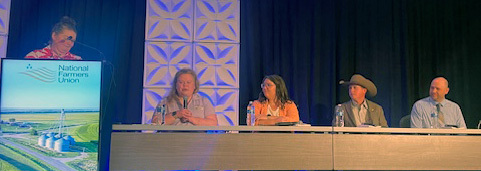
NEW ORLEANS — The National Farmers Union highlighted young farmers at this year’s convention here, including a panel of young farmers to talk about why they chose farming, the barriers they face, and what gives them hope.
Rather than focus on government policy, the panel talked about the practicalities of the operations and the loneliness they often feel amid the negativity of older farmers.
Breanna Reed, an Indiana farmer, said she raises sheep under solar panels. She noted that on their second date her now-husband took her to see sheep. “I thought they were fluffy and beautiful but I would never do anything with them. Now they are the center of my life,” she said.
“People tell me I am crazy but good luck,” Reed said.
She said that her most important decision was to import a ram from Canada that improved the genetic pool of her sheep.
Kaeloni Latham, a South Dakota farmer, noted that she did not grow up in agriculture and said everything she knows about agriculture has come since she married her husband and was introduced to cattle in 2014.
The first year was great, then the market crashed and she learned what it’s like to be personally involved in agriculture, Latham said.
“I have to have a day job to support my husband’s farming,” she said. “I work for a bank.”
Latham said it is important to support local communities so that there is a local bank officer to make decisions “instead of some guy in Chicago.”
“Complacency is the death of an operation,” Latham added. “Every year new technology is coming out. We need to figure out how to use it as a tool.”
Tim Bates, an Oklahoma farmer who also operates an agricultural services business, described himself as a first-generation farmer.
“Success is being able to have cash flow,” which he gets from his ag services business, Bates said. A successful farmer is one with “a wife with a town job,” he added.
Old folks are never happy, even if it rains, he said. “To be positive in a negative environment is hard.”
Bates noted that when he paid $1,800 for farmland, older farmers questioned his decision, but it is now worth $3,300 per acre.
Mike Seifert said he is a fourth-generation Minnesota farmer, but has to try to make a living on the 67 acres his parents turned over to him.
Seifert has adopted regenerative row crop practices, makes maple syrup and sells hay directly to the horse market. To survive, he said, he has to innovate.
Seifert said he wants to farm in an ecological manner, but faces the question of whether he is able to write himself a pay check.
His closeness to the Twin Cities of Minneapolis and St. Paul means he is closer to markets, but also that land is more expensive, he said.
All the panelists said that building community has been vital to their success in farming and that joining Farmers Union has been part of that.
“On the hardest days I have phone numbers I can call,” Reed said.
Devon Wilson, the owner of Sunlight Gardens in an impoverished area of Battle Creek, Mich., said he was farming two acres but is closing in on 15 acres.
Wilson, who has a store called the Farmacy, called for greater unity between rural and urban farming, even though there are a lot of differences. Urban farms are so much nearer consumers, but rural farms can grow so much more, he said.