Schumer introduces Family Grocery and Farmer Relief Act
Senate Minority Leader Chuck Schumer, D-N.Y., and other Democrats on Thursday introduced the Family Grocery and Farmer Relief Act, legislation they say would “break up dominant meatpackers, rein in foreign controlled corporate giants, and use federal tools to stop unfair pricing that drives up grocery bills for American families and hurts workers, farmers and ranchers.”
“As Trump tries to distract the American people with endless conflict and military adventurism, Senate Democrats are laser-focused on lowering the skyrocketing cost of living,” Schumer said in a news release.
“The pernicious stranglehold of the meatpacking monopoly has weakened our supply chains and price gouged consumers at the grocery store. This not the ‘Golden Age’ Donald Trump promised. But it’s what this administration does best — cater to special interests and corporations at the expense of middle-class families. That’s why Democrats are going to do what Donald Trump refuses to do: put the affordability crisis front and center, every day, all year long.”
The legislation is co-sponsored by Sen. Cory Booker, D-N.J., who is in line to become the highest ranking Democrat on the Senate Agriculture Committee if Sen. Amy Klouchar, D-Minn., the current ranking member gets elected governor, and other Democrats.
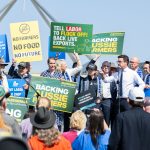
The Senate Democrats released the bill at a news conference at the National Press Club, and the bill and the reaction from the meat industry received wide news coverage in rural America.
Schumer said The Family Grocery and Farmer Relief Act:
- “Makes it unlawful for a major meatpacking conglomerate to control more than one major type of meat, forcing the biggest players to choose a line of business;
- “Imposes hard caps on the concentration of beef markets at both the regional and national levels. If these thresholds are exceeded, the FTC [Federal Trade Commission] must order targeted divestitures — selling off plants, facilities, or business units, or spinning off new independent firms — until markets are competitive again
- “Directs the Federal Trade Commission to design and enforce divestiture plans, so the law delivers real structural change, not just fines that companies treat as a cost of doing business, while maintaining or improving employment, honoring collective bargaining agreements, and promoting safer and more stable workplaces for workers across the supply chain.
- “Prohibits foreign leverage over the domestic meat market, empowering FTC to protect competition and national security;
- “Links the bill’s structural reforms to kitchen-table prices by focusing on unfair and unjustly discriminatory pricing practices in retail and wholesale meat markets that hit independent and neighborhood grocers hardest;
- “Authorizes the Small Business Administration to provide financial assistance, loan guarantees, technical assistance, and other support to farmers’ cooperatives and small business concerns that seek to acquire, operate, or expand meatpacking plants or facilities divested under the act;
- “Makes failure to divest enforceable under the FTC act, backed by significant civil penalties.”
The Meat Institute, which represents the meatpacking industry, said the bill “will destroy the meat packing industry, sending costs for consumers soaring, reducing union jobs, and harming livestock and poultry producers.”
“This proposal is absurd,” said Meat Institute President and CEO Julie Anna Potts. “Schumer’s bill and other efforts to villainize meat packers is simply reckless election year pandering that threatens to damage a crucial industry at the center of every American meal.
“If the senator is trying to make meat and poultry more affordable for consumers, this is the wrong approach. It will have the opposite effect. While this may be just a messaging bill to Sen. Schumer, it is real life for American families, farmers and ranchers and for the 3.2 million Americans employed throughout the industry.”
“Such a foolish proposal would never even be considered in another industry,” said Potts. “Imagine the federal government mandating that Ford only manufacture trucks, while forcing them to sell off all their other vehicle lines to separate small businesses. It is unthinkable in a free market. They don’t even do that in Russia anymore.
“This proposal assumes there are well capitalized and capable buyers lining up to enter the meat and poultry business, and that with the flip of a switch production would simply continue,” said Potts.
“This is a dangerous fantasy — these facilities are expensive, hard to run efficiently and safely, and are part of a complex value chain.
“Who has the capital and industry expertise to buy and operate these facilities? Will the government approve and finance buyers? Will they help run the facilities to ensure the new owners can ensure worker and food safety? What happens if there are no buyers for certain facilities? What will happen to the thousands of workers, many who are union workers, whose jobs simply disappear? Who will process the animals raised by area farmers then?,” Potts said.