Two CSU leaders join 2026 Colorado agriculture inductees
HOF2-RFP-011926
Two educators with decades of leadership at Colorado State University will be among the four agriculturists inducted into the Colorado Agriculture Hall of Fame at a banquet Feb. 26.
Tony Frank, who came to CSU in 1993 and now serves as chancellor of the CSU System, and Marlin Eisenach, the CSU Extension agent for Morgan County since 1987, are being recognized for the innovative approaches they’ve taken to advance and support Colorado agriculture while broadening opportunities for young people and strengthening rural communities.
The other 2026 inductees are Jennifer Gurr, who is retiring after serving in multiple roles at the Colorado Department of Agriculture in a 22-year career, and Jon Slutsky, a retired Colorado dairy farmer whose long history of service includes opening his dairy to CSU students and researchers.
Portraits of the four honorees will be displayed at CSU’s CoBank Center for Agricultural Education alongside those of 111 other agriculturists who’ve been inducted into the Colorado Agriculture Hall of Fame since 1989.
Announcing their selection, Stephanie Foote, chair of the Colorado FFA Foundation, commented that “they each exemplify the innovative, resilient and hard-working spirit of Colorado’s agriculture community.”
TONY FRANK
Parallels between Frank and Eisenach begin with their experiences growing up on family farms in the 1960s and ’70s. For Frank, that farm was a 400-acre plot a few miles from an Illinois town of about 200 people. The land provided enough space for four fields that could be planted on a four-year rotation, and also for a barnyard and livestock handling area.
“In those days, everybody did a little bit of everything,” Frank said. Societal and technological changes since then have led to more specialization, he continued, and operations that tend to be smaller or much larger: “The kind of farm I grew up on doesn’t exist anymore.”
For Frank, that speaks to the reality that innovation in agriculture is a necessity.
“To my mind, the big theme of agriculture historically, and I’ve certainly seen it over my life, is one of adaptation to change,” Frank said. “Looking at agriculture today — the remote sensing applications, the use of drone technologies, genetic engineering, and biochemical or biogenetic applications — I think the pace of change and the utilization of technology is pretty impressive.”
The path for Frank to stay involved in agriculture and support it through these changes led in an unexpected direction. Originally planning to become a large-animal veterinarian, he met his future wife in the Doctor of Veterinary Medicine program at the University of Illinois. After both earned D.V.M. degrees, he accompanied her to Indiana, where she had been offered a job as a small-animal veterinarian. While there, Frank completed a Ph.D. in comparative pathobiology at Purdue University, along with residencies in pathology and toxicology, and shifted toward a career in higher education. They left Indiana when he was offered a position as an assistant professor of toxicology and veterinary medicine at Oregon State University.
After five years in Oregon, Frank moved to Colorado with his family in 1993, starting at CSU as an assistant professor of veterinary pathology and then taking on a succession of roles leading from department chair to vice president for research and then provost. He became CSU’s president in 2008 and served in that role until 2019, continuing even after taking on additional responsibilities in 2015 as CSU System chancellor, his current role.
“At CSU, it was as simple as I cared about the organization, and I hoped I could do as good a job as people seemed to think I could do,” Frank said.
Frank’s leadership at CSU and the CSU System has been characterized by innovation, strong support for agricultural research and education, and a focus on rural communities, among other areas of emphasis. As chancellor, he helped imagine and build CSU Spur, a unique campus that opened in 2022 on the grounds of the National Western Center in Denver and is designed to engage the public, including students of all ages, in research and career possibilities involving food, water, and human and animal health. Recognizing the importance of international collaboration in agriculture, he helped establish the North American Agricultural Advisory Network, which is hosted by the CSU System.
CSU Vice President for Engagement and Extension James Pritchett, who nominated Frank for the Hall of Fame, commented on the strategic foresight apparent in Frank’s leadership.
“He understands that innovation requires courageous risk‑taking, talented researchers, sustained investment, and structures that reward new ideas and interdisciplinary thinking,” Pritchett said.
Frank’s efforts to support rural communities include expanding high-speed internet access through the System’s Broadband Initiative as well as a Rural Initiative, launched in 2021 with a multi-year, $8.6 million investment from CSU System Board of Governors, focused on enhancing statewide programming and support offered through CSU Extension.
Frank also has deepened CSU’s connection to the National Western Stock Show, serving on its board of directors. He’s the recipient of numerous honors throughout his career, including being named the stock show’s 2018 Citizen of the West in recognition of his commitment to agriculture and his success upholding the West’s agricultural heritage and ideals.
Reflecting on the layers of connection between CSU and Colorado agriculture and its rural communities, Frank noted the special role Extension plays in helping farmers make use of new technologies and research findings, and in helping young people develop as leaders and find their paths, whether leading toward agriculture or in different directions.
He noted how a fellow 2026 inductee highlights the significance of the Extension agent’s role.
“As early as I can remember after I came to CSU, Marlin was already this big figure within his community and was fully integrated there,” Frank said. The impact Extension agents can have is striking: “You pluck Marlin out, and Fort Morgan doesn’t look the way Fort Morgan looks.”
MARLIN EISENACH
Like Frank, Marlin Eisenach grew up on a family farm and expected that to be his future. Both participated in 4-H and FFA programs, benefiting from the Extension networks in each state.
Eisenach’s family farmed a 160-acre plot in Fort Morgan and, after graduating from CSU in 1965 with a degree in animal science, Eisenach returned to farm alongside his brother. In 1987, he became Morgan County’s Extension agent, serving a county east of Denver that’s now home to about 30,000 residents.
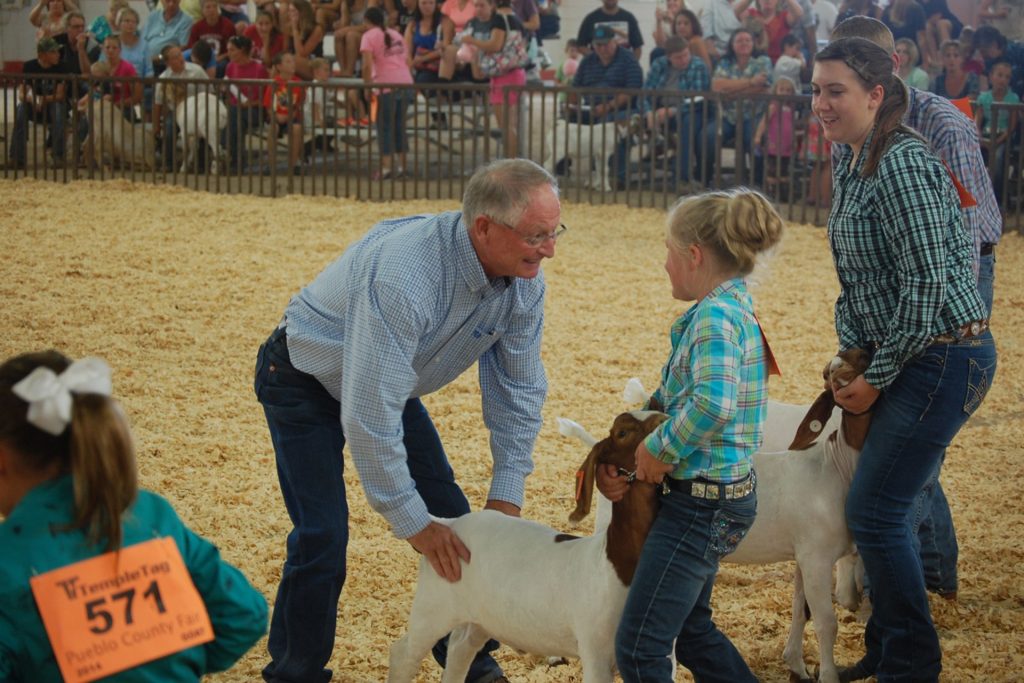
With almost 40 years in that role, Eisenach is deeply rooted in Fort Morgan, the county seat, and he’s also connected across the state and country through the young people he’s supported, the programs he’s started and sustained, and the many roles he’s filled, including decades as a livestock superintendent at the Colorado State Fair and the National Western Stock Show.
Technological advances, combined with social and economic changes, keep Extension agents busy as they interpret research and help farmers develop new approaches that allow them to succeed. “That’s why I rely on CSU so much because the researchers are on the cutting edge,” he said.
As rural communities change and agricultural job possibilities expand to include programmers and drone operators, 4-H, FFA and other youth programs supported by CSU Extension play a critical role helping young people find opportunities, both within their communities and beyond.
To illustrate the impact, Eisenach described the “Catch-It” programs he has championed, which provide an opportunity for kids who may not live on farms to take home an animal and care for it, and eventually show it at a county fair. He recalled how one participant, Paul Chard, raised a heifer and formed a lifelong interest in dairy.
Chard completed his doctor of veterinary medicine at CSU in 2003 and is now a veterinarian in the nearby community of Brush, where he is owner of Cattleman’s Resource, a company focused on animal care.
Another program emerged almost 30 years ago, after Eisenach spent time at an elementary school and realized that many kids, despite living in Fort Morgan, did not understand agriculture and the work involved in making food available at the supermarket. He partnered with the National Western Stock Show and the local Colorado Cattlemen’s Association chapter to create a program that targets the county’s third graders and offers hands-on experiences, including trips to the stock show.
“I went to that group and I said, ‘We’ve got to do something,'” Eisenach recalled. “We have youth here who don’t understand where their food comes from.”
COMMITMENT TO COLORADO
Finding new ways to make a difference in agriculture and in rural communities is a shared goal for Colorado Agriculture Hall of Fame members.
Another 2026 honoree, Jennifer Gurr, spent 22 years at the Colorado Department of Agriculture and is retiring as chief administrative officer and director of human resources. The FFA Foundation, announcing the inductees, noted Gurr’s leadership and ability to collaborate, including her work bringing the department’s multiple metro-area locations together on a single campus and her efforts supporting construction of a new laboratory. Gurr served as interim Colorado Commissioner of Agriculture in 2015.
For Jon Slutsky, a retired dairy farmer who owned and operated La Luna Dairy in Wellington, north of Fort Collins, the honor reflects his impact as an advocate for the dairy industry, including service on state and federal commissions focused on air and water quality. He also was a member of the Colorado Livestock Association board of directors, and he welcomed CSU students and researchers to his dairy, serving as a mentor, role model and partner.
In a letter supporting Slutsky’s nomination, Frank outlines ways he left a “lasting imprint” on Colorado agriculture.
“Jon is a true industry leader who has influenced generations of people to pursue careers in the field he loves,” Frank wrote.
The Colorado Agriculture Hall of Fame is presented by the Farm Credit Associations of Colorado.