Flies: The cattleman’s ‘F’ word
Flies1-RFP-061526
In the cattle business, some battles never seem to end: drought, mud, markets, extremist propaganda and flies. While flies may be the smallest enemy on that list, they’re often the most relentless, minus a few of the aforementioned extremists.
These tiny blood-feeding pests may be small, but their impact on cattle behavior, weight gain, stress levels and ranch profitability is anything but minor. Every summer, producers wage war against these airborne F words that seem determined to test both cattle and cattlemen alike.
THREE MAJOR CRIME FAMILIES
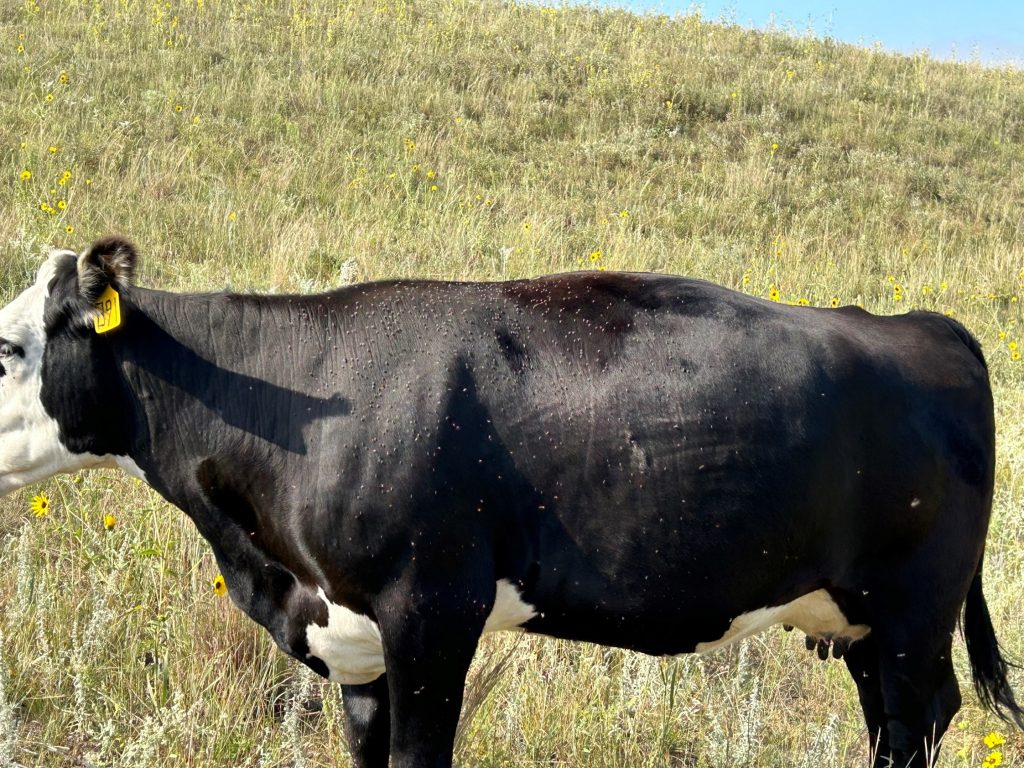
If cattle pastures had organized crime families, the horn fly would be the old-school boss. He’s always on the cow, collecting his cut one blood meal at a time.
The face fly is the slick middleman. He’s always hanging around the eyes and spreading trouble wherever he goes.
And then there’s the stable fly, the muscle of the operation. He can be found working the legs, delivering painful shakedowns and making sure nobody stands comfortably for long.
THE FACE FLY AKA “TONY TWO-TEARS”
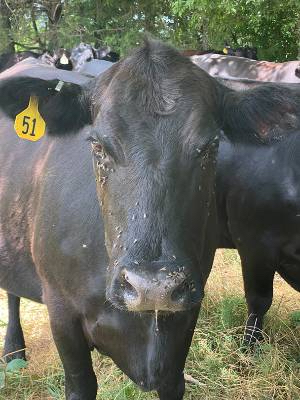
The Face Fly (Musca autumnalis), resembles a large, dark house fly and can be found around the eyes, nose and mouths of cattle.
That’s because unlike the horn and stable fly, these frustrating flies do not bite cattle to feed themselves. Instead, they feed on tears, mucus, saliva and other secretions around the face, costing ranchers money by reducing productivity and increasing disease transmission.
In particular, the face fly is often the culprit behind the transmission of Infectious Bovine Keratoconjunctivitis (IBK), better known as pinkeye. Pink eye causes cattle to experience excessive tearing, eye inflammation, corneal ulcers, temporary blindness and has shown to reduce weight gain in calves. When flies move from an infected animal to a healthy one, they can spread the bacteria associated with pinkeye. This is one reason pinkeye outbreaks often coincide with peak face fly populations.
Cattle dealing with face fly harassment will often violently shake their head and blink excessively to help rid themselves from these pesky visitors.
THE STABLE FLY AKA “FRANKIE FRONT LEGS”
The Stable Fly (Stomoxys calcitrans), is often called the “biting house fly,” because of their similarities in appearance. Many cattle producers consider it one of the most painful and frustrating fly pests in the pasture.
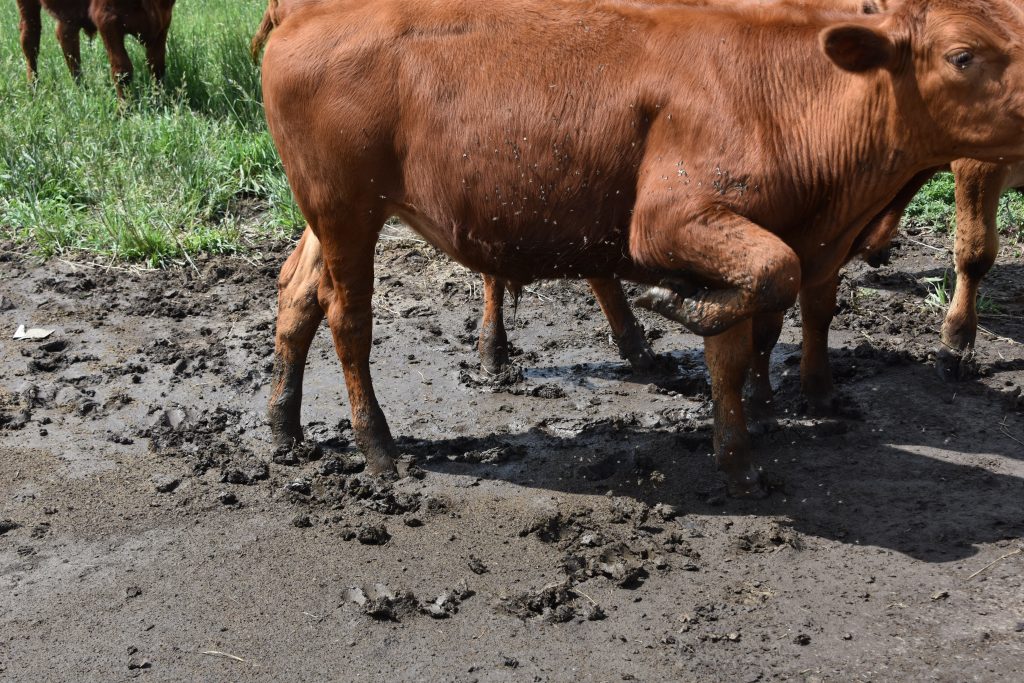
The Stable Fly spends it’s time on the lower half of the cow, concentrating their painful blood meals on the legs, lower belly and brisket. Unlike their cohorts on the face, stable flies feed on blood. And lots of it. One stable fly can feed up to 30 times per day, causing excruciating pain with each blood sucking stab to the legs or belly. Once they are full, the stable fly will leave the animal, often for a shady spot in a wind break where they will digest their meal and then return again and again, causing cattle to stomp their feet, bunch in corners, swish their tail, seek water to stand in and ultimately spend less time grazing.
As few as five flies per leg is enough to cause economic losses for producers when it comes to this blood thirsty pest.
THE HORN FLY AKA “DON VITO THE BACK RIDER”
Horn flies (Haematobia irritans) are much smaller, about half the size of a house fly and are often grayish black in color. While the face and stable fly only visit the animal to feed, the horn fly spends its entire life riding around on its bovine host.
These unwanted riders can be found around the horns, along the back, between the shoulders and the down the sides of cattle when the weather is cooler. To make themselves more comfortable when the weather heats up, they will migrate downward where they can enjoy the cooler temperatures of the shady underbelly.
The average horn fly will feed on blood anywhere from 20 to 30 times per day, making them a constant frustration for cattle and can hit ranchers hard where it matters most: their profit. In fact, a horn fly infestation can decrease not only milk production but also weaning weights by up to 14%.

THE STING
If flies are public enemy No 1, then Dave Boxler would be the guy in charge of taking them out. The fuzz. The heat. A G-man through and through. He’d be the head of the Fly Bureau of Investigation.
When Boxler isn’t masquerading as a fake fly-BI agent in this article, he’s actually an Extension educator at the West Central Research and Extension Center in North Platte, Neb. He provides the community with insect identification, general insect information and helps producers with insect control. In addition, he also conducts research studies on insects that affect livestock and provides that information to local, state, and national livestock producers.
He is the fly guy and he knows his stuff.
“Flies are well-suited for survivorship,” Boxler states bluntly. Which makes his job of researching ways to control them difficult at times.
“When a female horn fly lays her eggs, the next generation of fly will emerge within 12 to 14 days,” he continues.
Boxler has made a career out of studying fly behavior in order to better control these pests. Recognizing the signs of animal defensive behavior early can be key to positive outcomes when it comes to fly control.
According to Boxler, there’s a point where flies stop being just a nuisance and start hitting rancher’s bottom line. That’s known as the economic threshold, or the number of flies on a cow that begins costing a producer money.
For horn flies that number is 200. The stable fly threshold is much lower coming in at five flies per leg.
“What does 200 flies look like? That can be hard to determine, especially out in the pasture. If you look at the animal defensive fly behavior, you can determine if control methods need to be implemented,” Boxler explains.
“Pick out an animal and watch it for 1 minute. If they toss their head violently toward their back more than 10 times in that minute, you have a face fly or horn fly problem that merits control. If they stomp their feet more than 10 times in that minute, you have a significant stable fly problem that requires the same,” he continues.
THE ECONOMIC EFFECTS AKA “THE TAKE”
Flies are profit thieves.
Flies can drastically reduce feed efficiency. When cattle spend more time fighting flies than grazing, the lack of feed efficiency starts costing producers money. Instead of turning grass into delicious and nutritious beef, a cow fighting flies is turning a lot of that grass into tail switches, head tosses and foot stomps.
In addition to reduced weight gain, cows will also experience a drop in milk production causing slower growing calves and ultimately a loss of pounds to take to the sale barn in the fall.
“High fly populations will increase the stress of cattle which can have a negative affect on their reproductive health as well,” Boxler explains.
“It can affect everything from conception rates to the welfare and marketability of your cattle,” he continues.
Boxler said to imagine a rancher shipping 100 calves in the fall. If a summer’s worth of fly pressure leaves each calf 15 pounds lighter at weaning, that’s 1,500 pounds that never made it onto the scale.
That’s a lot of money riding off into the sunset behind a cloud of flies.
THE SOLUTION AKA “THE TAKEDOWN”
“You’ve identified that you have a problem, so it’s time to implement a control method. If you’ve identified that you have a problem and you’re already using a control method, it’s time to change because it’s not working.” Boxler states.
Boxler says that identifying the type of fly and knowing its behavior is key to effective treatment.
The stable fly lays its eggs in decaying organic matter like wet hay, old feed and even old hay stacks. The face and horn fly lay their eggs in fresh manure pats.
As mentioned before, the horn fly spends its entire life on the cow while the face and stable fly only visit the cow to feed and spend their time elsewhere while digesting and breeding.
Knowing these habits producers can target areas of concern for control.
Ear tags containing fly control can work well, but they need to be applied right before peak fly populations make their appearance. The problem with this is often the timeline a producer needs to get cows to grass, bulls turned out and other spring works done and in the books. Often times fly control ear tags are put in too early in the spring and lose their effectiveness by the time they could be beneficial.
Boxler said in his research that the best way to manage adult flies on the cow is the use of a mist blower. The portable contraption is loaded with either a pyrethroid or organophosphate. The blower blasts small particles of the control method over cattle for an effective and immediate knock down of flies. This method is the best for controlling horn flies as they are a constant presence on the cow. Because the horn fly will spend the heat of the day under the cow, it’s important to use this method during cooler temperatures to ensure the enemy is in the proper location for elimination.
The downside to these blowers is the cost. Boxler said they can be pretty pricey but that the benefit to the producer can pay for itself in a single season, depending on the size of the herd.
Mist blower applications can also be effective in treating the stable and face fly as long as producers are vigilant and know where to find these shade seekers.
“Mist blower applications can be effective on stable and face flies by targeting the shady areas in wind breaks, barns, stalls or other places they go to digest their blood meals,” Boxler explains.
Keeping corrals and feeding areas free of decaying hay and old feed is critical in the control of the stable fly.
THE DUNG BEETLE CONUNDRUM
Insect Growth Regulators are an effective tool to combat flies because they target the next generation of flies rather than the adults currently bothering the herd.
The cow ingests IGR via a feed through product. The IGR passes through the animal undigested and is deposited in the manure pat. When the adult fly lays eggs in the steaming pile, the IGR will prevent the larvae from maturing into an adult fly. This is of course the quick and simple version of how this widely used product works.
There are two types of IGR. The most common is Altosid and it is really only effective in controlling the horn fly. Diflubenzuron also known as Clarifly to most can better control the face fly and stable fly.
Altosid does not harm the dung beetle. Clarifly on the other hand has been shown to have a negative impact on the dung beetle.
Fly pupa overwinter in the space between the manure pat and the soil. When the humble dung beetle is not present, there are more places for flies to not only survive the winter but thrive the next spring.
So, to wrap it up, Altosid only controls horn flies. Clarifly controls them all, but hurts the dung beetle. Fewer dung beetles to break up manure pats causes excessive amounts of early spring flies.
The use of IGR’s also requires consistent use and they are not immediately effective in the demise of these flying pests, but they are effective when used correctly.
Still with me? Good.
BACK POUR OR “BACK POOR?”
Back pour products are expensive.
Depending on the product you use, the size of the animal and the dosage, it can cost a producer anywhere from $3 to $6 dollars per animal.
“These products are made for individual applications. To get the results you want, you have to apply them correctly,” Boxler states.
One can imagine that if Boxler was present at any given cow working that he would want to send all of us producers to the clink for any number of infractions.
He says for effective control the product needs to be used keeping a few things in mind.
Know the weight and measure the correct dose, don’t guess.
Apply the product down the entire topline from shoulders to tail head. Yes, the entire topline. Not just between the shoulders. Or along the side. Or as fast as you can because you forgot and already let her out.
Apply to dry animals only and not when there are rainy or wet conditions expected immediately after application.
A few other common mistakes according to Boxler include applying too little product, using a fly-control product after fly populations have already exploded, repeatedly using the same active ingredient year after year, which can contribute to resistance and expecting pour-ons alone to provide season-long control.
WHATS NEW?
Boxler and a research team from the University of Nebraska and the USDA have been doing extensive research on the effects of fatty acids derived from palm and coconut oils for fly control.
“We understand the interest in natural products. These fatty-acid derived products are very safe for the animal, the applicator and the environment,” Boxer explains.
After nearly two decades of research, Boxler said there’s enough data to get the product submitted to the Environmental Protection Agency to start the label issuing process.
“We are seeing mortality in 30 seconds with these products. In addition, they have shown the ability to repel flies as well,” Boxler said.
He added that the USDA has been working on their similar product with the addition of essential oils to increase the repellency.
“These products are not only a repellant but have a lethal component. The EPA process takes anywhere from nine to twelve months, so I think in the very near future we will have some new and effective products hitting the market,” Boxler says enthusiastically.
Boxler is also optimistic about the prospect of using drones to help keep flies at bay in a pasture setting. He mentions that drones are already in use in a variety of other agriculture fields like crop spraying, noting that the nozzles would need to be changed to apply a mist over cattle as opposed to larger drops.
“Producers are already using drones for herd monitoring; the logical next step is to use them for fly control. The cost of drones is coming down. It’s the way of the future for fly control,” Boxler states bluntly.
THE BUMS-INEFFECTIVE PRODUCTS
Boxler said over the years they have done extensive tests on some non-traditional fly control methods, including a producer favorite: garlic.
The research tests that Boxler and his team conduct span over several years and are tested on hundreds of head of cattle to determine effectiveness.
“When I give presentations and talk about garlic for fly control, I always put up the control group photo and the garlic treated photo and ask the audience to guess which cow is being treated with garlic products. It’s always about 50-50; there’s no difference in the cows treated and the ones that aren’t,” Boxler said.
He also said that he loves to get producer feedback and had a producer ask him once about the effectiveness of apple cider vinegar. He headed down to the local grocery store, bought them out of ACV, conducted his testing, although much shorter lived than tests conducted using other products. While he said two hours after application there were a few less flies, by the next morning the test subjects were completely infested again with flies.
“Have you ever priced apple cider vinegar? It’s expensive, it would not be a cost-effective treatment even if it did work,” Boxler joked.
IN CONCLUSION, YOU FILTHY ANIMALS
In the end, this trio of flies may be small, but they’re responsible for one of the biggest heists in cattle country. From skimming pounds off calves, to spreading pinkeye and stress across the pasture, to keeping cattle stomping instead of grazing, these pests can quietly chip away at a producer’s bottom line all summer long.
The good news is that ranchers aren’t helpless bystanders. With a solid fly-control program that combines good management and strategic insecticide use, producers can keep the mob on the run and protect both herd performance and profitability.
If you need more information on fly control or advice on how to administer it in your program, give the fly guy a holler.
Dave Boxler can be reached via email dboxler1@unl.edu, call his office at (308) 696-6721 or visit extension.unl.edu for educational materials regarding fly control.