USDA chief economist assigns staff to study retail sector
SugarMeet-RFP-081026
VAIL, Colo. — Agriculture Department Chief Economist Justin Benavidez said here Tuesday that he has assigned one of his senior economists to study the retail sector for the first time.
Asked by The Hagstrom Report at the American Sugar Alliance’s International Sweetener Symposium whether he has analyzed the impact of GLP-1 drugs and the declining world birth rate on global food demand, Benavidez said his office has not traditionally done as much work on food demand as on production. But he added that he has assigned Rebecca Nemec Boehm, a senior economist on his immediate staff, to study “the retail side.”
Benavidez added that he wants “to deliver a little more expertise on those trends” and that he will “try to expand that capacity going forward.”
Major retail food companies have taken an interest in these trends as consumer preferences and shopping habits have changed, but farm and commodity groups have not shown much interest in the impact of either the GLP-1 drugs used to fight obesity and diabetes by reducing hunger pangs or the declining world birth rates.
According to her official USDA biography, Nemec Boehm “has expertise in how domestic food and agriculture policy impacts U.S. agricultural producers. She has worked on analyses related to farm income, impacts of regulations on farmland values, drivers of conservation practice adoption, food price inflation, and forecasting changes in food assistance program participation. She also serves as principal investigator for one of USDA’s Policy Research Centers.”
Nemec Boehm grew up in California’s Central Valley and got her start at USDA as a research intern with the Agricultural Research Service in Parlier, Calif., collecting soil and water samples from alfalfa fields on the western edge of Fresno County. She received her Ph.D from the Tufts Friedman School of Nutrition Science and Policy and her bachelor of arts from Princeton University.
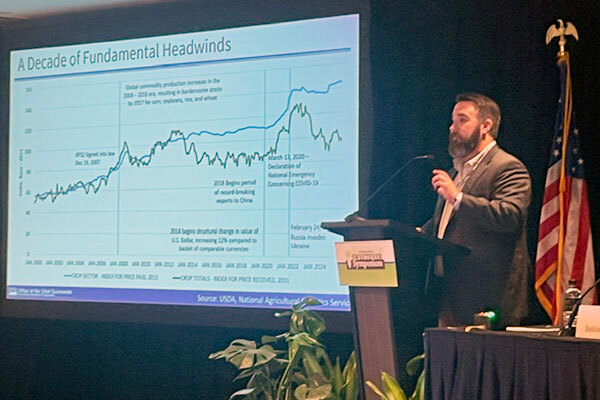
In his speech to the beet and cane growers, Benavidez said that U.S. agricultural production has experienced “a decade of headwinds.”
Production took off in other countries that have become competitors and the U.S. dollar has been strong, he said. Finally, there has been the Russian invasion of Ukraine and the war in the Middle East.
The result has been a shift from cycles in agriculture to “shocks and response,” Benavidez said.
The past decade has been dominated by ad hoc assistance to farmers, he said. The next question is whether the provisions in the One Big Beautiful Bill Act will change that or whether there will still be more ad hoc aid.
The debt-to-equity ratio has been relatively stable, but non-real estate debt has grown, he said.
Analyzing specific crops, Benavidez said corn has had record-breaking exports in the past year. The closure of the U.S. border to Mexican cattle to keep out New World screwworm has led Mexico to import more corn to feed its cattle that would have gone to the United States.
Cotton and oil prices have moved together. When oil prices get too high, cotton is used as a replacement for oil, he said.
Wheat production is at a historic low, he noted.
Rice is seeing higher prices due to the monsoon season in India, he said.
Drought remains a key driver in the Plains, particularly Texas, and in the Pacific Northwest, Benavidez said.
Even after the Strait of Hormuz is opened, there will be a delay in the shipments of fertilizer or oil while ships are filled and move to the Port of New Orleans, he said. In addition to analyzing the situation in the Strait of Hormuz, his office is also studying problems in the Suez Canal and the Panama Canal.