FMI, Meat leaders greet Kennedy, defend manufacturing in video
MAHA-RFP-030926
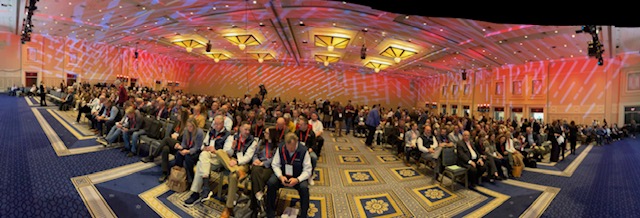
OXON HILL, Md. — Leslie Sarasin, president and CEO of FMI-The Food Industry Association, and Julie Anna Potts, president and CEO of the Meat Institute, warmly welcomed Health and Human Services Secretary Robert F. Kennedy Jr. to the groups’ joint Annual Meat Conference here today.
But they also participated in a video released by the National Manufacturers Association defending food manufacturing that Kennedy has criticized.
Kennedy, who has spoken more positively about meat than any federal official in decades, got a standing ovation when he stepped on the stage of the Gaylord National Resort & Convention Center. He got a second standing ovation after a “fireside chat.”
(Meat sales hit a record high of $112 billion in 2025, with a pound increase of 2%, with millennials and Gen Z as a driving force behind the growth, according to the 21st annual Power of Meat report released on March 2.)
Answering questions posed by Sarasian and Potts, Kennedy, 72, said he had always exercised but “ate what he wanted to” until he reached an age at which he “had to.”
But he said he had become acquainted with the work of Sean O’Hara, a medical doctor who raises the issue of “visceral fat” that is stored deep within the abdominal cavity, wrapping around vital organs like the liver, stomach and intestines.
Under O’Hara’s guidance, Kennedy said, he learned that he had visceral fat and was in danger of atrial fibrillation — heart arrhythmia. He began a diet of meat and fermented vegetables, including kimchi and sauerkraut.
After 30 days, Kennedy said, his visceral fat went away and his brain function improved, with better word retrieval and name recognition.
Kennedy said he is likely to stay on the diet of meat and fermented vegetables for the rest of his life. He said a “large number” of Cabinet members including Transportation Secretary Sean Duffy are now on the diet, adding that Vice President JD Vance started the diet on Ash Wednesday and has pledged to stay on it through Lent.
He joked that Secretary of State Marco Rubio said Vance was in a bad mood but that the vice president was in a better mood by Saturday night when they had dinner.
ULTRAPROCESSED FOODS
Under further questioning, Kennedy repeated many of the same points he has made criticizing the American diet in recent decades and blaming chronic disease on ultraprocessed foods. He also said that the Dietary Guidelines for Americans developed by the Biden administration were influenced by “mercantile” interests and were more than 400 pages long.
During the development of the new dietary guidelines, Kennedy said, the “biggest battle” was over saturated fats because there are “information gaps” on the impact of saturated fats.
He repeated past statements that Americans did not die from heart attacks in 1900, but that after President Eisenhower had a heart attack in 1955, people were searching for the reason.
Kennedy maintains that there is no science that links heart attacks to saturated fats, but that the American Heart Association had adopted the work of Ancel Keys, a researcher that Kennedy maintains left countries that had high rates of meat consumption and low rates of heart attacks out of an influential study he did.
Kennedy said that the American Heart Association took up the view that saturated fat leads to heart attacks and got money from Procter & Gamble, which makes Crisco, a vegetable oil. (The American Heart Association has disputed Kennedy’s account.)
Kennedy said the replacement of meat with carbohydrates has led to the United States having “the sickest population,” with chronic disease that costs the country billions of dollars a year and 38% of children being diabetic or pre-diabetic.
Kennedy said he wants people to eat more meat protein so they get more amino acids. “Most plants do not have the complete chain of amino acids,” he said.
He maintained that the Trump administration is “doing our best to make sure protein is affordable and available.”
THE GUIDELINES
The dietary guidelines “have the potential to drive a transformation in dietary culture” because the Trump administration will use the guidelines to change what the government buys through nutrition programs including school meals, and is changing the foods that will be available on Indian reservations and military facilities and in prisons.
Defense Secretary Pete Hegseth and Robert Irvine, a celebrity chef, have changed the food on five military bases and will soon make the change on 20 total. Soldiers who were leaving the bases to buy fast food are lining up to eat on bases where the food has been changed.
The Trump administration is considering sending people around the country to teach Americans how to shop for groceries and to cook, he said.
Asked what he would tell Trump about should be done about the health of Americans, Kennedy did not respond directly but said he wouldn’t want to have that conversation on Air Force One.
Kennedy said Trump usually eats a healthy diet at the White House and at Mar-a-Lago, but on Air Force One he prefers to buy food from big companies because he thinks they produce safer food. Kennedy recalled the famous incident in which Trump served him a Big Mac from McDonald’s.
Kennedy’s complaint about Trump’s diet is that the president drinks Diet Coke at every meal. One person who has known Trump for 20 years said he has never seen him drink water, Kennedy said.
“Food is medicine, it has the capacity to restore our health,” Kennedy said. “It’s not just our physical health, it is our emotional health.”
Fermentation, he added, “is important to rebuilding the microbiome.”
“Food affects our mental health” and kids who eat food dyes are more likely to get ADHD, attention-deficit/hyperactivity disorder, he said.
He said a professor at Harvard has determined that the keto diet improves schizophrenia, that changing the diet at prisons to “real” food reduces violence, and in juvenile facilities reduces the need for restraints.
“We have a spiritual malaise” due to isolation, Kennedy said. Cooking meals together is “a sacred ritual,” while too many kids go to their rooms, eat fast food and watch social media, he said.
Sarasin, whose organization represents grocery stores, said she “absolutely loved” Kennedy’s comment about family meals, and noted that FMI has a project called Family Meals Month, which it is turning it into a movement.
Kennedy said that he hopes the food industry will join the collaboration between the Food and Drug Administration and the National Institutes of Health on food and health. He noted that Kyle Diamantas, the FDA deputy commissioner for human foods, is in charge of that project.
In conclusion, Sarasin said FMI and Kennedy “are much more aligned” than people might think.
But Sarasin and Potts are also the leading spokespersons on a 9-minute video produced by the National Association of Manufacturers defending food manufacturing. The video features a wide range of food manufacturing lobbyists.
In September NAM President and CEO Jay Timmons said the Make America Healthy Again Movement will take America in the wrong direction.