Commodity leaders call on Congress to act on E15
E15-RFP-030926
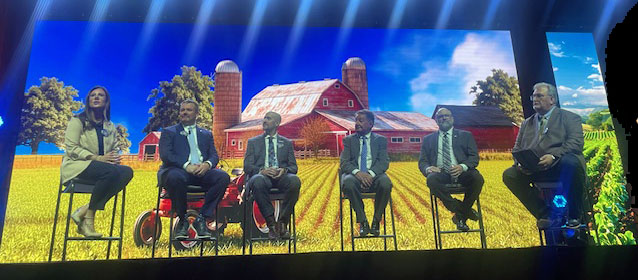
SAN ANTONIO — Leaders of key commodity groups gathered here on Thursday for the Commodity Classic called on Congress to reach agreement on a bill to allow the sale of E15 gasoline year round nationwide and to finish a five-year farm bill.
On a panel in the general session, National Corn Growers Association President Jed Bower, an Ohio farmer, said that the group is “in communication daily” with the House Republicans who are trying to finish a bill that will satisfy both the ethanol industry and the small refiners who are trying to get provisions in the bill to benefit their industry.
“Our side is holding firm. We are holding a line in the sand,” Bower said. “We need E15 now. We can’t wait until the end of the year.”
The ethanol industry is “relying” on House Speaker Mike Johnson, R-La., “to manage his members in the House,” Bower added.
With a massive corn crop expected, Bower also called on input suppliers to “help us market” the grain.
Amy France, a Kansas farmer who is chairwoman of the National Sorghum Growers, added, “One-third of sorghum goes into ethanol.”
She also said sorghum growers are excited about the potential of President Trump’s trade deal with India though she noted that “no boats have been loaded yet.”
American Soybean President Scott Metzger, an Ohio farmer, said he hopes the Trump administration will release the renewable volume obligations (RVOs) for oil refiners and importers to blend specific volumes of renewable fuels by the end of March.
Mexico is the No. 2 buyer of U.S. soybeans, Metzger said, citing the importance of the continuation of the U.S.-Mexico-Canada Agreement on trade.
(Brian Kuehl of Farmers for Free Trade stood outside the general session handing out stickers calling for the continuation of the USMCA.)
National Association of Wheat Growers President Pat Clements called for Congress to pass the rest of the farm bill, which the House Agriculture Committee is scheduled to mark up on Tuesday.
That bill, known as “farm bill 2.0” because it covers the sections of the farm bill that were not in the One Big Beautiful Bill Act, contains a provision to move Food for Peace, the nation’s largest international food aid program, from the U.S. Agency for International Development to the Agriculture Department, Clements noted.
“It makes sense to move Food for Peace to USDA,” Clements said.
But he added, “We are in a price squeeze, every commodity is. We need higher prices, lower input costs. Tariffs are not good for our business. They are bad for the input side, for the export side.”
Kurt Coffey, the vice president of IH Case North America who represented the Association of Equipment Manufacturers, said it’s vital to maintain the USMCA.
The United States, Canada and Mexico are “an inseparable economy,” Coffey said. “We have customers across the border.”
Farm equipment, he added, allows “relatively unskilled labor to be productive.”
At the end of the session, all the panelists called for the passage of farm bill 2.0.
Metzger noted that the bill will improve farm credit programs.
Clements said, “We need certainty. We need to know export programs are going to exist for five years, that crop insurance [will be there] for five years. Farming is a long-term business. We can’t operate on ad hoc payments.”