Fuel and fertilizer: The other ‘F’ words
Screenshot
You don’t have to sit long at the parts counter or any given sale barn café before you’ll start to hear a few choice F words start floating around in conversation — fuel and fertilizer. They’ll come accompanied by a shake of the head, a low whistle or a heavy sigh.
Fertilizer and fuel currently sit at the forefront of producer’s minds because they are the No. 1 input costs for farmers while the latter is the No. 1 cost for folks that make their living hauling food, fertilizer, cattle and hay over the road.
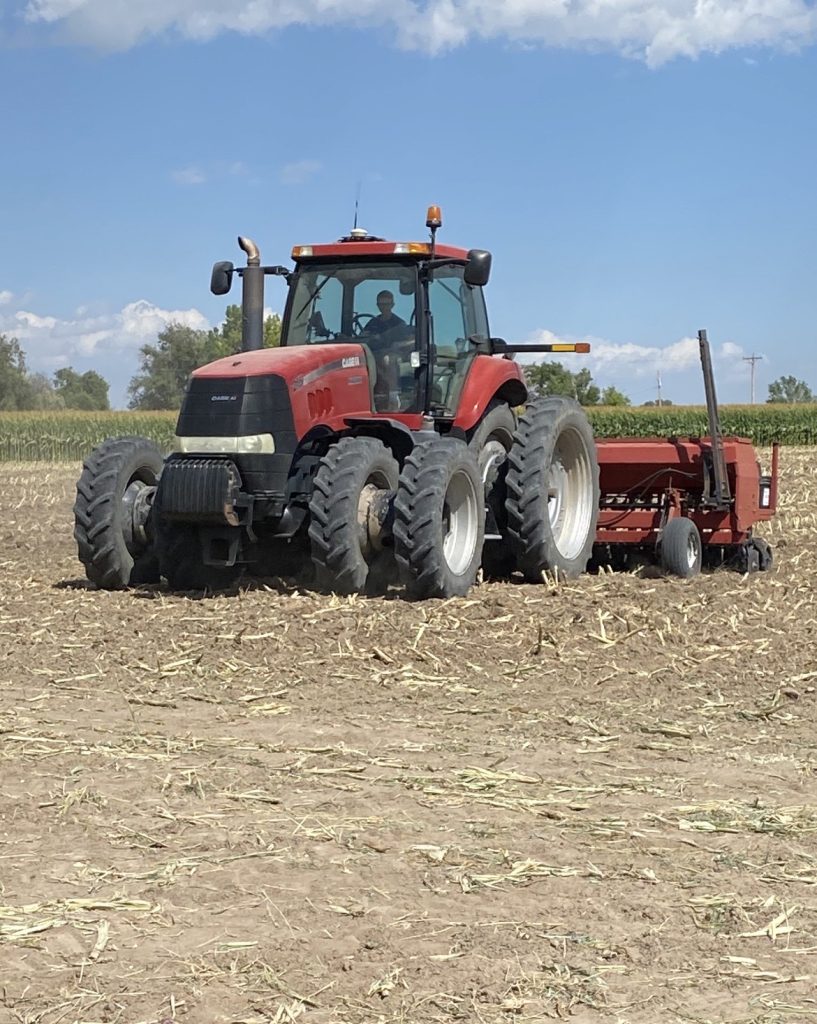
When farmers start talking about average input costs, it’s generally broken down into the cost per acre, or the amount of money it costs them to plant one acre of seed. The cost per acre to get corn seed in the ground can be upwards of $500 per acre for farmers, not taking into consideration any breakdowns, repairs, pesticides, chemicals, fuel, land rent, labor, water and electricity expenses which can push that cost as high as $1,000-$1,200 dollars per acre.
By the time a farmer looks out the back window of the tractor at his freshly planted field, he’s already spent most of what he hopes to make that fall.
To add insult to injury, most counties across eastern Colorado, southeastern Wyoming and western Nebraska are currently experiencing varying levels of drought, with not much relief in sight.
THE FERTILIZER
“It’s a double-edged sword,” said Ryan Johnson, an agronomist for Legacy Coop in Torrington, Wyo.
“Not only are farmers dealing with high input costs, but they’re dealing with drought. The decisions I’m seeing guys make when it comes to planting or changing their programs have more to do with the lack of moisture than the cost of fertilizer.” Johnson said.
Ryan Draegert, an agronomist for CHS, Inc. in Brush, Colo., said producers in that area are feeling the same pinch from both sides.
“With significant drought occurring and high input costs such as fertilizer, fuel, water and equipment, all farmers have to make calculated and educated decisions on their spring planting,” he said.
“While the prices of fertilizer have significantly increased, the drought we are experiencing has caused the demand to go down. Due to lack of water, some prevent planting is being done so the demand on fertilizer has been less. Additionally, the low price of commodities slowed the end of year 2025 pre-pay program so many farmers were already planning on less inputs for the spring of 2026,” he said.
Both Johnson and Draegert agree that the ongoing war in the Middle East has caused some significant issues with certain fertilizers sourced from that region.
“The routes that the imports take has been directly impacted by the war in Iran and the disruptions in the Strait of Hormuz,” Draegert stated bluntly.
Dry Nitrogen, or urea, is the most commonly used product imported from the tumultuous region.
According to Johnson, dry nitrogen has increased a staggering 35% just since December in his corner of Wyoming.
The United States does have the ability to produce commonly used fertilizers domestically, however the production of urea and anhydrous rely largely on natural gas to produce them. Natural gas is cheap in the Middle East making it cheaper for them to produce. These products can be imported significantly cheaper than they can be produced here at home.
There are nitrogen plants in Iowa, Oklahoma and Texas.
Phosphorus is produced in places like Florida, Idaho and North Carolina, with potash plants dotting Utah and New Mexico.
While suppliers do rely on domestic production of these inputs, they rely more heavily on the imported and cheaper versions.
Ultimately when the outside supply stumbles, U.S. farmers feel the pinch.
THE FUEL
Quinton Draegert is a certified energy specialist for CHS High Plains in Brush, Colo.
A big part of his job is monitoring market conditions for fuel and noted some considerable changes since December of 2025.
“Refined fuel prices, at the rack, have more than doubled since December. Propane, on the other hand, has remained relatively flat, largely due to the mild temperatures we experienced throughout the winter, which kept demand lower than usual,” Draegert said.
From his standpoint on the sales end, Draegert said that he has seen farmers taking a more cautious approach when making decisions about one of their highest input costs.
“We’re seeing an increase in partial loads, with customers opting to top off tanks rather than fill them completely for the summer. This reflects the uncertainty in the market and a desire to manage costs more carefully,” he said of the trends he’s seeing.
Taking these steps to tighten up margins and attempt to mitigate losses, farmers are having to put pencil to paper to come up with some options to help ease the pain at the fuel pump.
“While input costs remain high, it’s become even more important for producers to stay in close contact with their suppliers and specialists in the field and take advantage of programs that can help manage risk and price volatility,” Draegert said.
“When prices first jumped in January, it didn’t seem like it would be long-term, but the longer it continues, the more it appears tied to ongoing geopolitical factors. Right now, this isn’t a supply-driven market — it’s largely being influenced by headlines and global events. Over time, we do expect things to stabilize, but in the meantime, staying proactive is key,” he said.
THE FARMER
Farmers across the nation are plodding down an increasingly bumpy road as they head into planting season 2026.
Sharp price increases for many inputs along with global conflict and significant drought are hitting them where it hurts: their profit margins.
“Its going to be a character-building year,” said Shawn Booth of Veteran, Wyo.
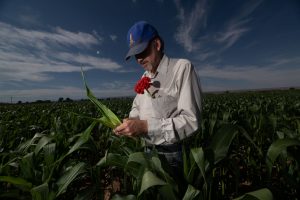
Booth, along with his family, farm corn and hay in the fertile farm valleys of southeastern Wyoming.
They also operate Booth’s Cherry Creek Angus, which has been selling Black Angus bulls for nearly 50 years.
Booth said the price of inputs is a big factor in their decision-making this spring, but what has been holding them hostage is the drought.
“We won’t know how much water will be coming down the ditch yet and probably won’t know until late May. We probably won’t get that water until June. It’s hard to plan for crops when you don’t have a guarantee,” Booth said.
“We usually plant around 400 acres of corn and we aren’t planting any this year. We are planting some forage sorghum, millet and last fall I planted some rye grass. Our goal is to get bales of feed in the stack yard and as much wet feed in piles as we possibly can. The goal this year is to find a way to keep the cows in the pasture,” he continued with a shake of his head.
Booth said that they generally raise about two to three times more feed than they can use so they can sell the extra, but there might not be any extra to sell this year.
“We didn’t fertilize the alfalfa fields because the input was too high. With the cost of the fertilizer and the lack of production because of the drought, it wouldn’t offset the input this year,” Booth said.
THE TRUCKER
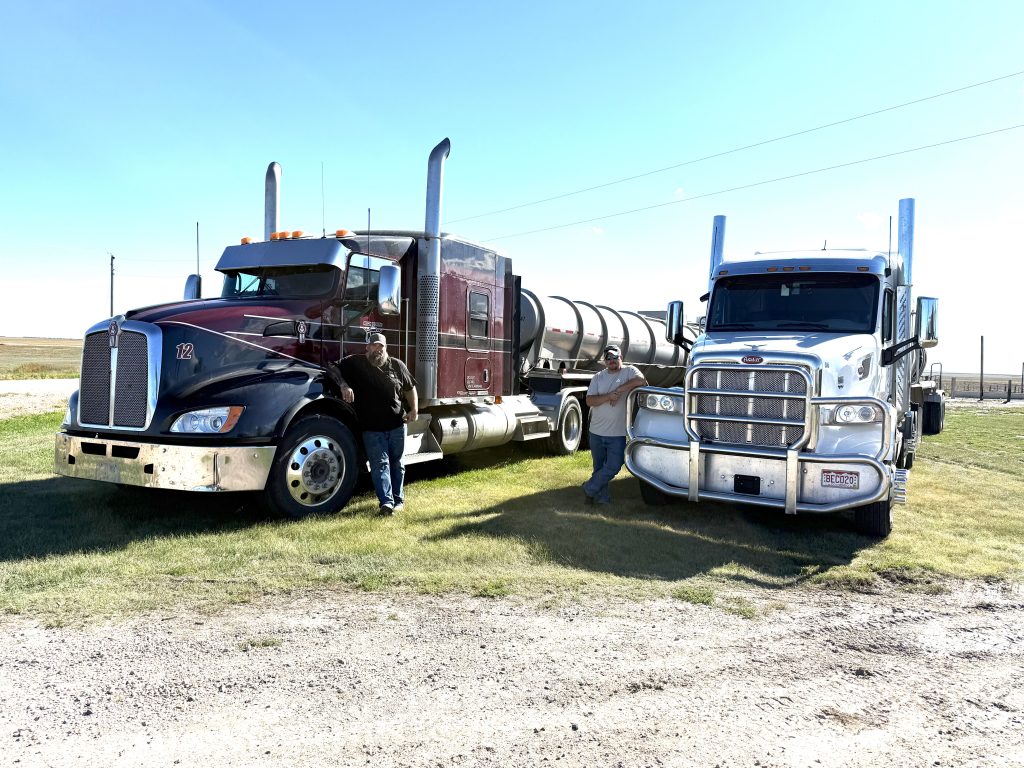
Eric Johnson owns and operates High Plains Trucking from his place outside Fleming, Colo.
Johnson said his fleet of six trucks and drivers is currently operating at 24% less profit margin than last year at this time and all of it is due to the cost of his No. 1 input: diesel fuel.
“The price of fuel is definitely affecting our bottom line. It’s making us get creative. We’ve got the work and we are blessed for that, but we are having to move money around and doing more business on credit,” Johnson explained.
“If the price of diesel and tires go down, this might just be enjoyable again,” he said with a chuckle.
Johnson said his business takes part in cash discounts and rewards programs when possible to try to alleviate the sticker shock at the pump.
“We use an app called 10-4. It operates on debit instead of credit and gives us discounts at networked locations. My guys have gotten really good at doing the math and knowing where to stop to get the best prices,” he said.
Johnson also said that they are taking it a little slower on the open road these days, slowing their speed to around 65 miles per hour to save fuel. He said they are able to keep the number of loads hauled the same but the work days are about three hours longer.
Johnson also said he feels the burden of having to pass those prices onto the customer.
“It’s tough because we know that it starts with us. Everything we haul gets rolled into the price that the farmer pays for fertilizer or other inputs,” he said.
Kyle Leoffler agreed.
“Most ranchers understand that the rates will have to come up. I try to keep fuel percentages of all loads down as much as possible,” the truck driver from Torrington, Wyo., said.
Through his trucking business, Leoffler Livestock Inc., Leoffler estimates he puts on around 7,000-8,000 miles a month hauling cattle, hay and other agricultural products.
“Just since the first of March, the cost for my fuel went up about $3,500, which ultimately affects the rates for the loads,” he said.
THE ACTS
Two bills have recently been introduced to both the U.S. Senate and the House of Representatives aimed at lowering costs, reducing volatility and giving farmers more control over their fertilizer purchases and provide some predictability.
The Fertilizer Transparency Act (S. 4152/HR 8104) was introduced to allow the government to provide timelier and up-to-date price information on fertilizer as well as allow the U.S. Department of Agriculture to monitor for price gouging.
The bill would shift the USDA away from compiling an annual, voluntary report to a weekly, mandatory report.
Rep. Dusty Johnson, R-S.D., one of the bill’s sponsors, recently told Suzanne Alexander of Market Day Report that the purpose is more to monitor supply and demand rather than bad behavior.
“If you’ve got good, regular data, I think it can sniff out bad behavior before it happens,” he said in the televised interview.
He also claims the bill will give producers the information they need to make better decisions on their fertilizer purchases.
Along the same lines, The Homegrown Fertilizer Act would aim to save producers money on the input by expanding domestic production as opposed to monitoring its ever-changing cost.
The bill would allow the USDA to provide low-interest loans and grants to projects that would improve domestic fertilizer production methods and enhance efficiency with that production.
Rep. Eric Sorensen, R-Ill., told Jared White of Brownfield Ag that everything being done now is helping to lower costs.
“To be honest, we’re really not producing much in this country,” he said of U.S. fertilizer production domestically.
“These loans and grants would go to smaller producers — not the four large consolidated fertilizer companies. More competition would lower the cost for producers,” he said.
AT THE END OF THE DAY
When it gets down to the nut cutting, those “other F words” aren’t just line items on a budget, they’re the difference between getting by and getting ahead.
Right now, they’re taking a bigger bite than most can afford.
Producers will keep doing what they’ve always done.
They’ll adjust where needed, endure the volatility, and push forward because that’s what those in the ag industry do.
If the gap between costs and returns keeps widening, it won’t just be a tough year. It’ll be a turning point.